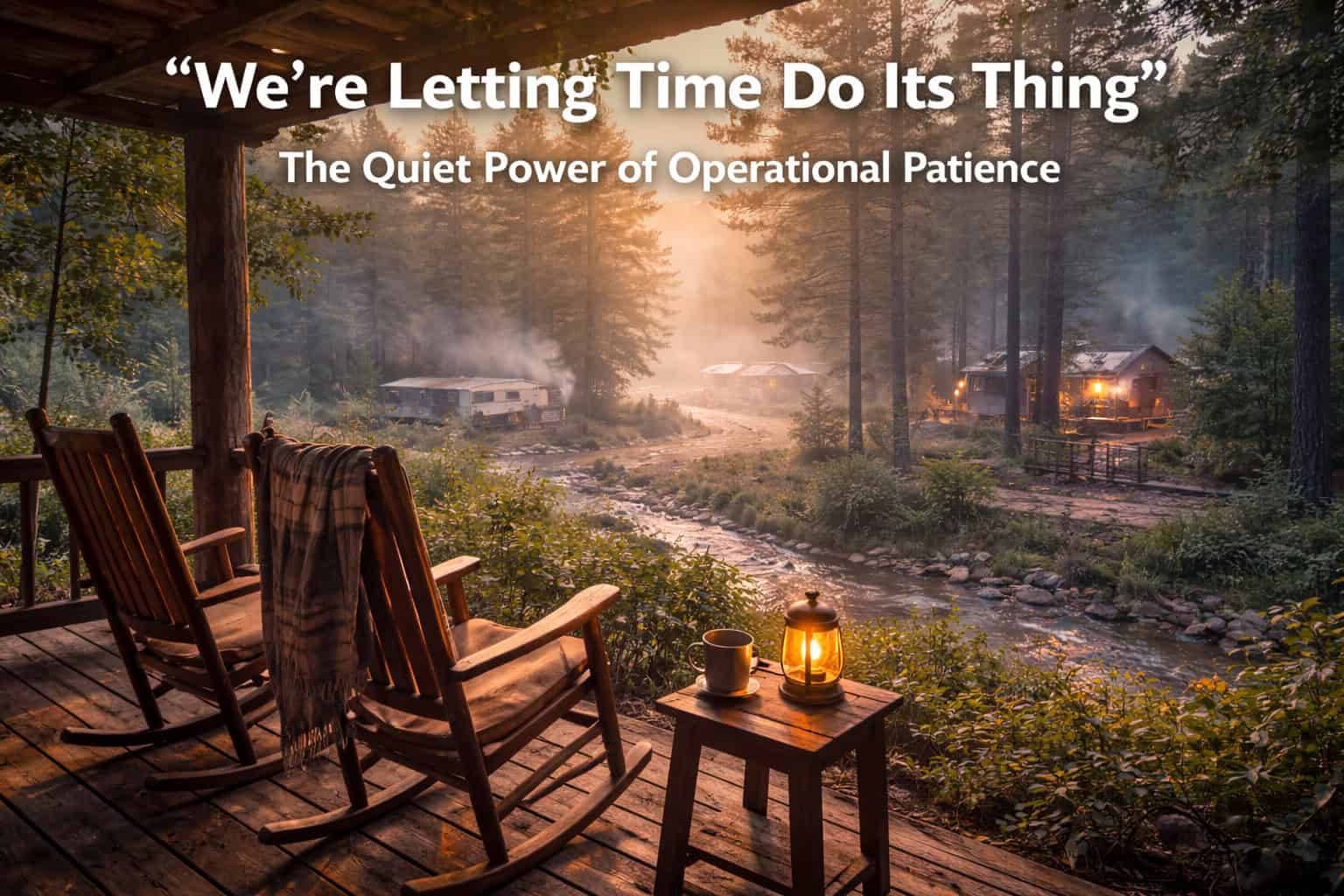
In the fast-paced world of business, we are taught to push, to accelerate, and to "disrupt." We want the grass to grow faster, the new concrete to cure instantly, and the brand-new staff to have ten years of intuition by their second week. But a seasoned campground owner knows that some of the most critical elements of a park cannot be forced. Sometimes, the most strategic move you can make is to step back and declare: “We’re letting time do its thing.”
This isn't about procrastination or neglect. It is about respecting the natural and operational cycles that require duration to reach maturity. It is the wisdom of knowing when to stop "Doing the Thing" and start letting the thing become reality.
1. The Physical Seasoning of the Land
You can grade a road and pour fresh gravel, but it isn't "Stable" until it has been lived on.
-
The Settling Process: Fresh earth needs a season of rain and weight to find its final form. By "letting time do its thing," you allow the land to reveal where the "Slight Shifts" will occur. A "Livable" site often needs a year of different rigs and different weather to truly "settle" into its best-case scenario.
-
The Ecological Layer: You can plant a row of privacy trees, but you can't "automate" their growth. Patience in the landscaping layer is what creates the "Familiar" shade and beauty that guests will cherish a decade from now.
2. Cultivating the Human "Vibe"
You can't manufacture a "community" overnight. A culture is built through the slow accumulation of "Optional Interactions" and repeated seasons.
-
The Maturation of a Regular: "Familiarity" takes time. You can’t rush the process of a first-time visitor becoming a legacy guest. It takes years of consistent "Stability" for a guest to feel like your park is their "home away from home."
-
Staff Intuition: You can train a team on the "Mechanism," but you can’t train the "Owner’s Ear." That level of "Interpretation" only comes when you let time provide them with the hundreds of unique scenarios that build true expertise.
3. The Strategic Wait
How do you know when to wait and when to work?
-
Observe the "Moving Parts": If you’ve just "Integrated" a new system or finished a major "Stage" of construction, resist the urge to immediately tweak it. Give it a full season to run. Let the "Conditions" test it.
-
The "Exhale" Period: Use the time you aren't spending on "reactive" fixes to focus on the "Layers" of your long-term vision. Letting time work on the physical park gives you the "Emotional Time" to plan your next leap.
-
Trust the Foundation: If you’ve "Accounted for It" and your systems are solid, the "Stability" will hold. Trust that the work you’ve put in will bear fruit if you just give it the space to grow.
Key Tip: The "One-Year" Rule. Before making a major change to a new site or a new policy, let it live through all four seasons. The "Slight Shifts" of winter, spring, summer, and fall will tell you more than any "Hypothetical" plan ever could.
Final Thoughts
"We’re Letting Time Do Its Thing" is an act of confidence. It shows that you trust your "Execution," your "Land," and your "Team." In an industry that is so often defined by the "Now," there is a profound competitive advantage in being the owner who can wait. When you give your park the gift of time, you aren't just maintaining a property; you are growing a legacy.
The best version of your park is still "Happening"—it just needs a little more time.
🐟 Want to give your guests a "Timeless" experience? Show them the beauty of a park that has been loved and seasoned over the years. CampgroundViews.com allows you to capture the current, matured state of your park in stunning 360-degree detail. Let your guests see the results of your patience and your passion.
Respect the process at CampgroundViews.com!