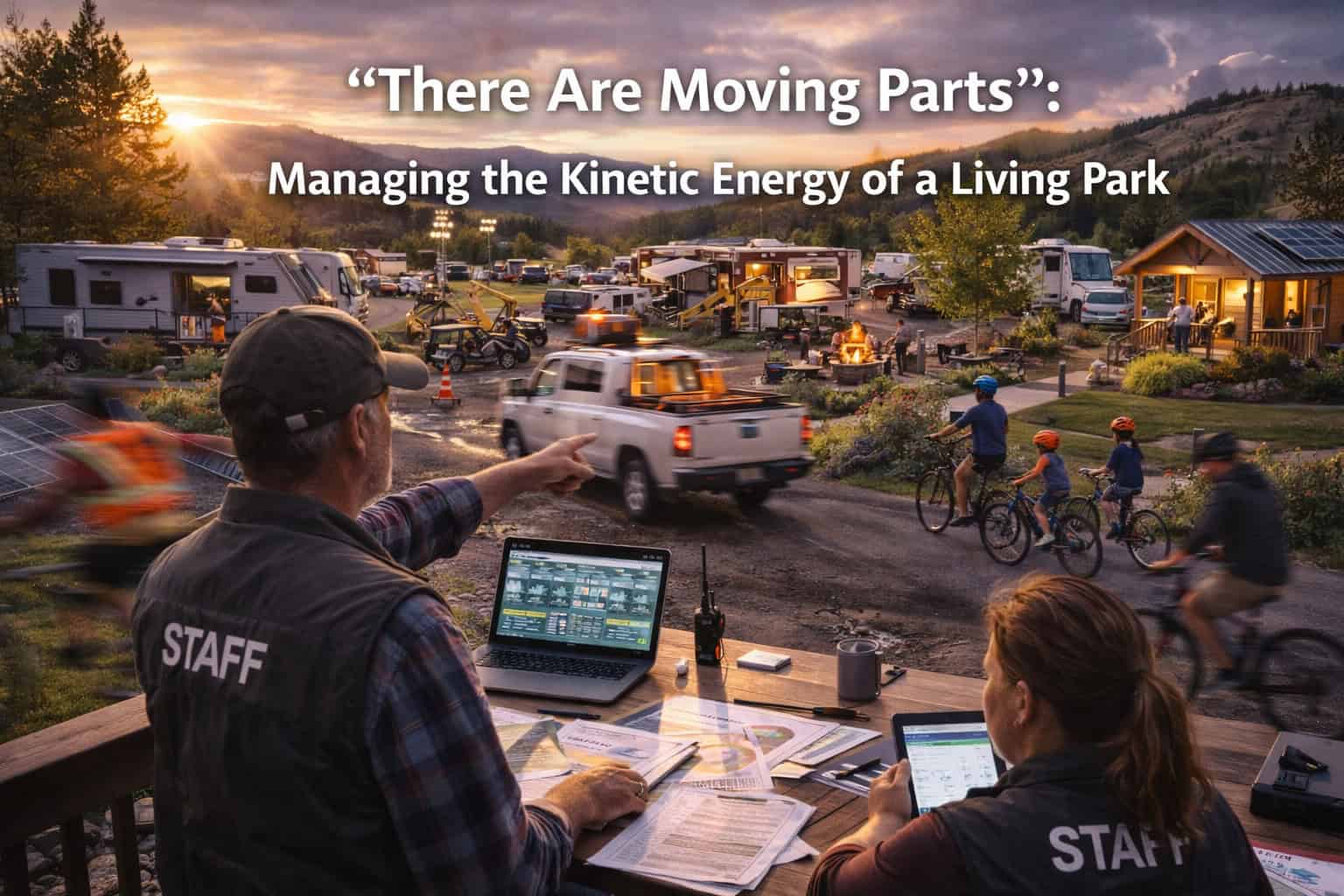
If you look at a campground map, it looks static—a series of fixed boxes on a piece of paper. But as soon as the sun rises, that map disappears and is replaced by a high-stakes dance. People are unhooking, kids are chasing dogs, delivery trucks are navigating narrow turns, and the local utility company is doing "routine" work at the entrance. In this business, you quickly learn: “There Are Moving Parts.”
Managing a campground isn't like managing a retail store where the inventory stays on the shelves. In your world, the "inventory" has wheels, the "customers" are living in your product, and the "infrastructure" is reacting to the weight of it all in real-time.
1. The Kinetic Nature of the Site
A site isn't just a location; it's a dynamic zone. Every time a 40-foot rig pulls in, the "Moving Parts" of your park are put to the test.
-
The Pivot Points: A site that worked for a travel trailer might be a "Complexity" for a fifth wheel with a different swing radius. "There are moving parts" means recognizing that every arrival is a unique mechanical event.
-
Wear and Tear in Motion: Gravel shifts. Turf compresses. Pedestal lids get bumped. Because your business is literally built on movement, your "Maintenance Layer" has to be equally mobile. You aren't just cleaning; you are recalibrating the park every single day.
2. The Human Velocity
It’s not just the RVs that are moving—it’s the people. The "Emotional Time" of your park is driven by the flow of human activity.
-
The Morning Rush: There is a specific energy to "Check-out Time." It’s a synchronized movement of dumping tanks, retracting slides, and final walk-throughs. When you acknowledge that "There are moving parts," you can position your staff to manage the flow rather than getting caught in the wake.
-
The "Unplanned" Variables: A guest decides to stay an extra day; another arrives three hours early. These moving parts can jam the gears of your "Technically Valid" plan if you haven't built in the "Buffer" we discussed in We’ve Accounted for It.
3. Synchronization: Keeping the Gears Greased
How do you manage a business where everything is constantly in motion?
-
Visual Communication: Because things move so fast, your "Integrated" signs and digital maps must be foolproof. If a guest has to stop and think, they become a "stopped part" in a moving system, creating a bottleneck.
-
Active Monitoring: Since "This Is Happening" in real-time, you need eyes on the ground. Whether it’s you on a golf cart or a "Mechanism" of smart sensors, you have to be able to see which parts are moving too fast or getting stuck.
-
Flexibility as a Feature: Don't fight the movement; facilitate it. Build your roads wider than the "Hypothetical" minimum. Design your check-in for the "Best-Case" speed. When you embrace the motion, the park feels alive rather than chaotic.
Key Tip: The "Fluid" Schedule. Don't schedule your most disruptive maintenance (like road grading or tree trimming) during high-velocity times. Identify the "Quiet Windows" in the moving parts of your week and strike then.
Final Thoughts
"There Are Moving Parts" is what makes this industry exciting. It’s the energy of a thousand different vacations intersecting in one place. While it requires a high level of "Interpretation" and "Stability" to manage, it’s also the sign of a healthy, thriving park. A park with moving parts is a park that is making money, making memories, and making progress. Keep the wheels turning.
🐟 Want to help your guests navigate the "Moving Parts" of your park with ease? Give them a head start. CampgroundViews.com allows guests to virtually see the "moving" reality of your park—the turn radiuses, the site depths, and the road widths. When they can visualize the movement, they arrive ready to flow.
Master the momentum at CampgroundViews.com!