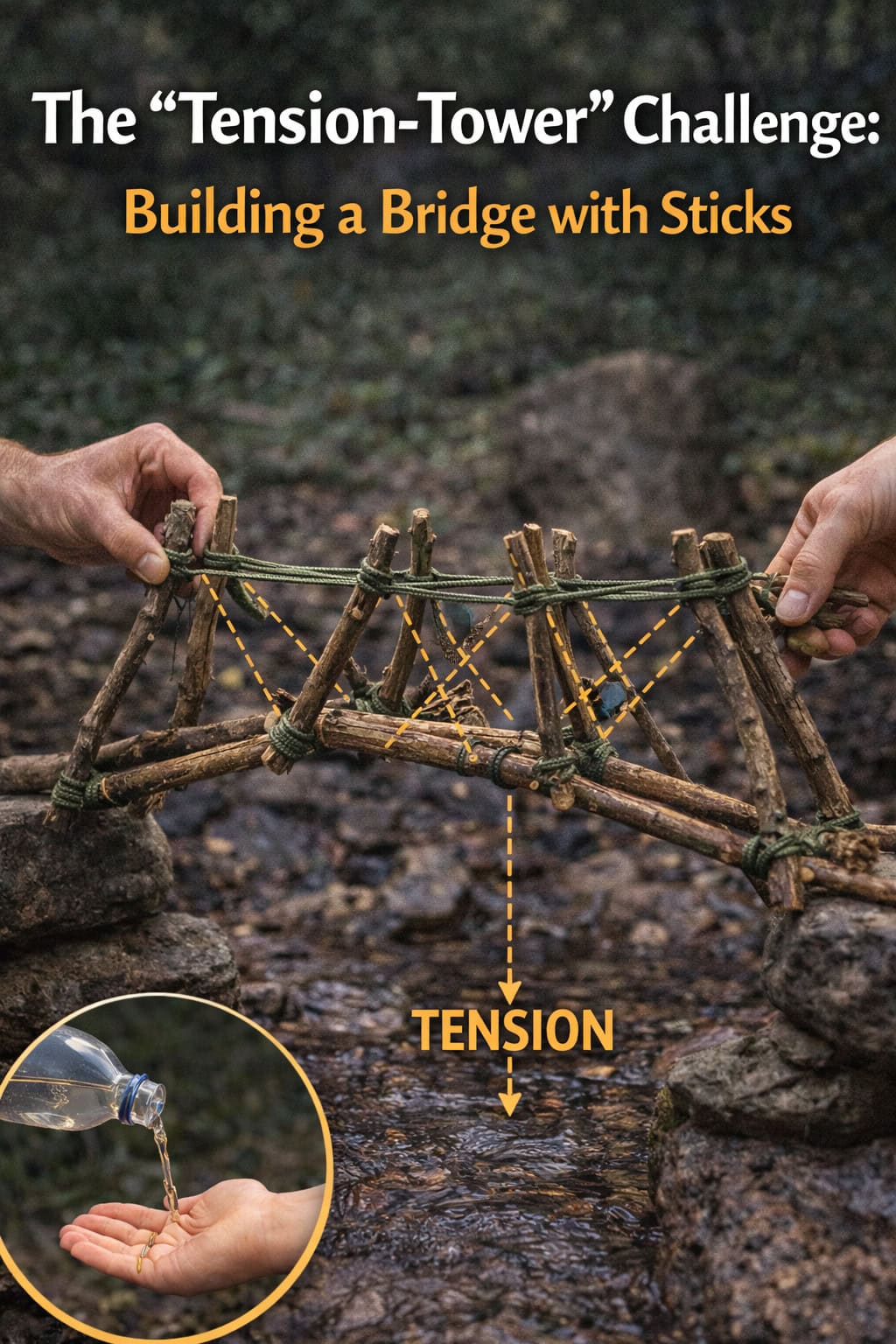
The Leonardo da Vinci "Self-Supporting" Bridge
Imagine you have a pile of sticks and no way to connect them. No rope, no duct tape, no nails, and definitely no glue. Most people would say it’s impossible to build a bridge that can hold weight. But over 500 years ago, a genius named Leonardo da Vinci designed a bridge that uses the most powerful tools in the universe: Gravity and Physics.
This is a "Tension-Tower" challenge. You are going to build a bridge that stays together because the harder you press down on it, the stronger it becomes. Here is how to master the Self-Supporting Bridge.
1. The Science of the "Duo" (Compression vs. Tension)
The Concept: To keep a bridge from falling, you have to balance two opposing forces.
-
Compression: This is the "Squeezing" force. When you stand on the bridge, your weight pushes the sticks together.
-
Tension: This is the "Stretching" force. As the sticks try to slide apart, they pull against each other.
-
The Physics: In a Da Vinci bridge, every stick is positioned so that the weight of the sticks above it locks the sticks below it into place.
2. The "Friction" Secret
The Science: Because there is no glue, the only thing keeping the sticks from sliding is Friction.
-
The Physics: Friction is the resistance that one surface encounters when moving over another.
-
The Action: The rougher the "skin" of your sticks (like pine or oak bark), the better they will "bite" into each other. If you use smooth, peeled sticks, your bridge might slide apart like a deck of cards!
3. The Build: Step-by-Step Engineering
You will need at least 12 sticks of roughly the same length (about 1 foot long is perfect).
-
The Base: Lay two sticks parallel on the ground. Place a third stick across them (the "crossbar").
-
The Lift: Take two more sticks and slide them under the crossbar, but over another stick further back.
-
The Weave: This is the tricky part. You continue "weaving" the sticks so that each new set of longitudinal sticks is held down by the weight of the previous crossbar.
-
The Result: You will see an arch begin to form. The arch shape is a "Compression Master"—it distributes the weight from the top of the bridge down into the ground.
4. The "Load Test" Challenge
The Science: Once your bridge is built, it’s time to test its Structural Integrity.
-
The Experiment: Find a small rock or a full water bottle. Carefully place it on the very top of the arch.
-
The Physics: Watch what happens. The bridge shouldn't wobble; it should actually become sturdier. The weight of the bottle increases the Normal Force (the pressure) between the sticks, which increases the friction and locks the "weave" even tighter.
5. The "Collapse" Lesson
The Science: Every bridge has a Failure Point.
-
The Physics: If you add too much weight, or if one stick is slightly crooked, the friction can no longer hold the tension.
-
The Result: The bridge won't just sag; it will "explode" (the sticks will all fly apart at once!). This is because all that Potential Energy you built into the tension is released in a split second.
-
The Engineering Fix: If it collapses, look at the sticks. Which one slid first? That’s your "Weak Link." Adjust your weave and try again!
Pro Tip: The "Notch" Hack. If you’re having trouble with your sticks sliding, use your pocketknife (with an adult’s help!) to carve a tiny "V" notch where the sticks overlap. This increases the surface area for friction to work, making your bridge strong enough to hold a whole backpack!
Final Thoughts
Building a Da Vinci bridge is a rite of passage for every Co-Captain. It teaches you that you don't need fancy tools to solve a problem—you just need to understand how to make the forces of nature work for you instead of against you.
Happy Building, Architect!
🐟 Want to find a site with the "Perfect Building Materials"? You want a site with lots of "Deadfall" (fallen branches) and a flat area for your bridge! CampgroundViews.com lets you take a 360-degree tour of the park. You can look for sites tucked into the trees where the ground is covered in the perfect "Engineering Supplies" for your Tension-Tower.
Find your "Construction Site" at CampgroundViews.com!