The Physics of the Strongest "Bridges" in the Campground
You’re walking to the bathhouse early in the morning when—THWACK—you walk face-first into a sticky, invisible net. After you finish doing your "I-just-walked-into-a-spider-web" dance, take a second to look at what you just broke.
You didn't just walk into a bug trap; you walked into one of the most incredible engineering projects on Earth. Pound for pound, spider silk is stronger than steel and more flexible than a bungee cord. Here is how to understand the "Architecture of the Eight-Legged Engineers."
1. The "Material Science" of Silk
The Science: Spiders don't just have one type of "thread" in their bodies; they are like a walking hardware store.
-
The Frame Silk: This is the "Dry Silk." It’s incredibly strong and acts like the steel beams in a skyscraper. The spider uses this to build the outer "spokes" of the web.
-
The Capture Silk: This is the "Sticky Silk." It’s covered in tiny droplets of "glue."
-
The Physics: Spider silk is Viscoelastic. This means it can stretch to twice its length and snap back without breaking. When a heavy fly hits the web at high speed, the silk "soaks up" the energy like a car's crumple zone!
2. The "Orb" Web (The Masterpiece)
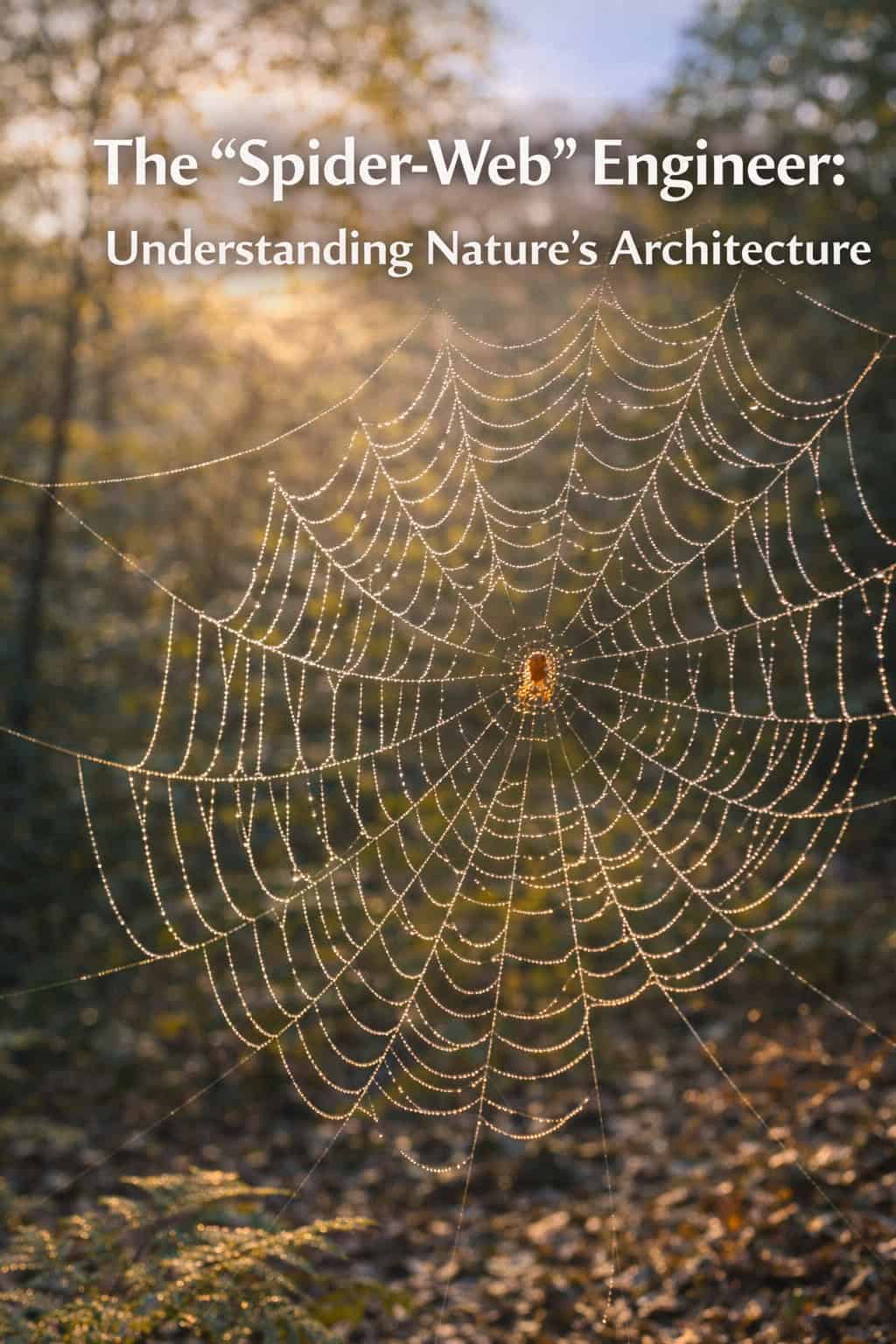
The Look: This is the classic "Halloween" web—a perfect circle with a bullseye in the middle.
-
The Engineering: The spider starts by throwing a single line into the wind until it "catches" a branch. Then, it builds a "Y" shape, then a frame, and finally the spiral.
-
The "Non-Stick" Hack: How does the spider run across its own web without getting stuck?
-
The Secret: The spider only walks on the "Dry Silk" spokes! It avoids the "Sticky Silk" spirals. Plus, spiders have special oily hairs on their feet that act like "Teflon" to prevent them from becoming their own dinner.
-
3. The "Funnel" Web (The Trap Door)
The Look: This web looks like a thick, white sheet of silk that disappears into a dark hole in a bush or between RV tires.
-
The Engineering: This isn't a "sticky" trap. It’s a Vibration Sensor.
-
The Physics: The spider sits at the bottom of the funnel. When a bug walks across the "sheet" at the top, the vibrations travel through the silk like a telephone wire.
-
The Result: The spider feels exactly where the bug is and "teleports" out to grab it before the bug even knows it’s on a web!
4. The "Sheet" Web (The Trampoline)
The Look: These are flat, messy-looking webs that cover the grass on a dewy morning.
-
The Engineering: Above the flat sheet, the spider strings up random "trip-wires."
-
The Action: A flying insect hits a trip-wire, tumbles down, and lands on the flat "trampoline" below. The spider is waiting underneath the sheet and pulls the bug through the silk like a ghost!
5. The "Dew-Drop" Lens Experiment
The Science: Because spider silk is so thin, it is perfect for catching Surface Tension.
-
The Observation: Find an orb web early in the morning when it’s covered in dew.
-
The Physics: Each tiny drop of water is a perfect sphere. Why? Because the water molecules want to stick together more than they want to stick to the silk.
-
The Magic: Each drop acts like a tiny Magnifying Glass. If you look closely, you can see the whole campground reflected upside-down inside a single drop of water on a spider's web!
Pro Tip: The "Web-Repair" Respect. If you see a web in a spot where people aren't walking, leave it alone! It takes a spider a huge amount of energy to create that silk. They actually eat their old webs at the end of the night to "recycle" the proteins so they can build a fresh one tomorrow!
Final Thoughts
Spiders are the world’s best structural engineers. They build complex, high-tension bridges and traps using nothing but materials they make inside their own bodies. The next time you see a web, don't think "Eek!"—think "Wow, nice architecture!"
Happy Engineering, Science Scout!
🐟 Want to find a site with some "Natural Architecture" to study? Look for sites near bushes or wooden fences! CampgroundViews.com lets you take a 360-degree tour of the park. You can scout for "Habitat Zones" (like leafy bushes and old trees) where the best Eight-Legged Engineers like to set up their "Skyscrapers."
Scout the "Web-Zone" at CampgroundViews.com!