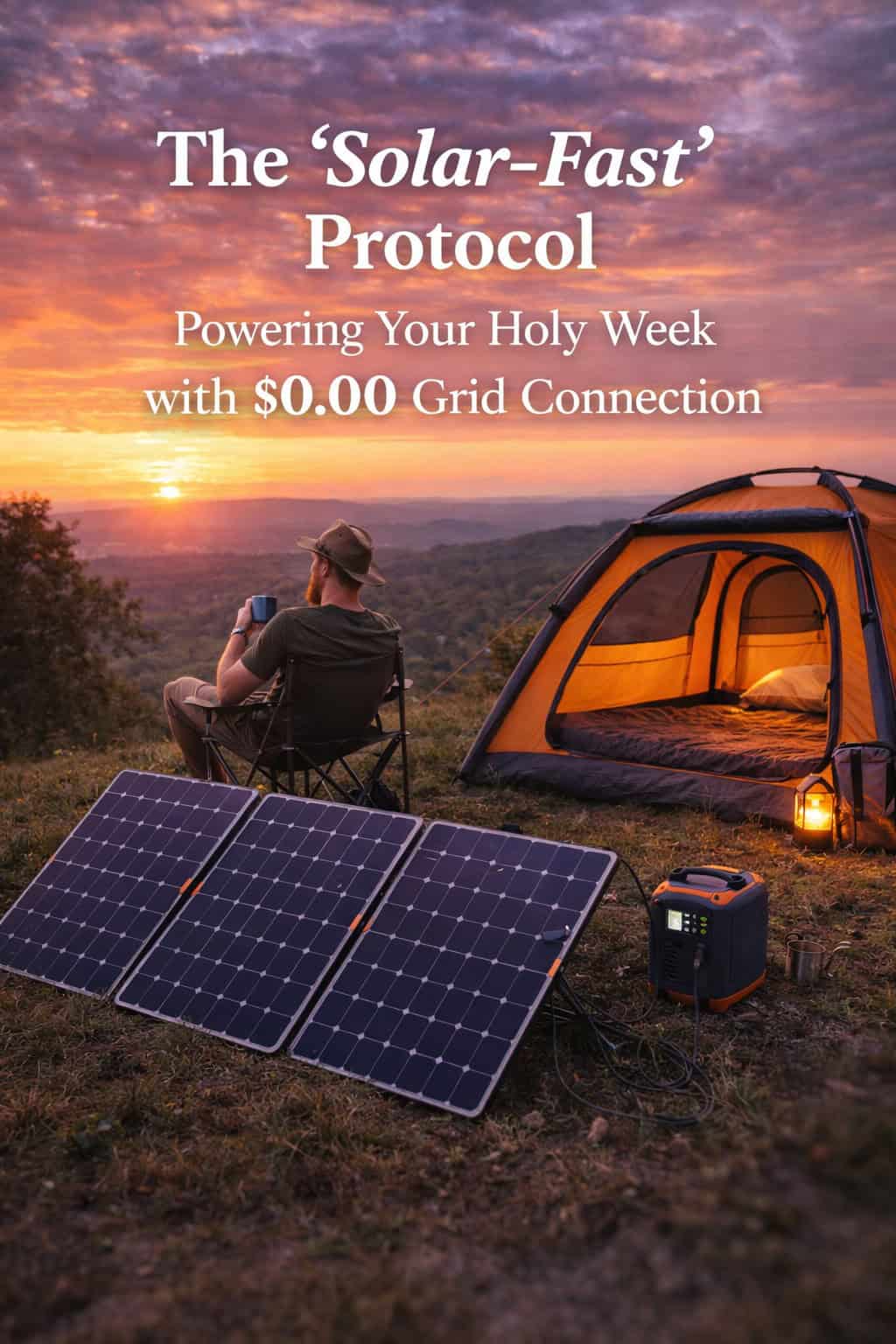
As we enter Holy Week 2026, a season defined by fasting and renewal, the outdoor community is adopting a different kind of discipline: The Solar Fast. With the Artemis II mission launching on April 1st and the sun hitting its optimal "Spring Tilt," there has never been a better time to sever the cord.
The challenge is simple but strict: Zero grid connection for seven days. No pedestals, no charging stations, and no gas generators. You are powered by the sun or you are in the dark. In 2026, thanks to the trickle-down of lunar-base technology, this isn't just possible—it’s the new standard for the self-sufficient scout.
1. The Tech: Gallium Arsenide (GaAs) Has Landed
For years, GaAs solar panels were the exclusive domain of Mars rovers and the Orion spacecraft. In 2026, they’ve finally hit the consumer market. Unlike traditional silicon panels which top out at efficiency, these new multi-junction GaAs panels are pushing .
-
The Benefit: You get the same power output from a panel half the size of your old silicon folding kit.
-
The "Low-Light" Miracle: GaAs is significantly more sensitive to the "blue spectrum" of light, meaning your Solar-Fast won't fail just because a spring cloud rolls in. They generate power at dawn and dusk when silicon panels are essentially dead.
2. The Budget: Accounting for the "Sky-Link" Hero
To survive the week, you need to manage your "Energy Bank" like a mission controller. Here is the 2026 daily power budget for a high-tech solo scout:
The Math: To stay "Grid-Zero," you need to generate roughly per day to account for inverter loss. A single GaAs folding panel can achieve this in just 5 hours of "Peak Sun."
3. The "Spring Tilt" Optimization
Geography is energy. In late March, the sun is still relatively low on the horizon. If you lay your panels flat on the ground, you are losing up to of your potential harvest.
The Solar-Fast Rule: Angle your panels at Latitude + . If you are in the Southern US, that means a to tilt toward the south.
-
The Scout Move: Don't just set it and forget it. Re-aim your panels at 10:00 AM, 1:00 PM, and 4:00 PM. This "Manual Tracking" is the difference between a full battery and a cold dinner on Holy Saturday.
4. The Protocol: Rules of the Sun-Powered Kitchen
To make the Solar-Fast work, you have to change when you use energy.
-
The "Solar Peak" Cook: Do your heavy cooking (boiling water for the "One-Pot" warm-up) between 11:00 AM and 2:00 PM. This uses "direct" solar energy, bypassing the battery and reducing wear on your power station.
-
The "Sky-Link" Window: Limit your high-bandwidth satellite usage to the "Artemis Launch" window or the "Comet MAPS" scouting times.
-
Passive Warming: Use the sun to pre-heat your water in a black hydration bladder before putting it on the induction stove. Every of free solar heat is energy saved for your "Silent Sunday" light.
Scout Your Sun Before You Stake Your Tent
A "Solar-Fast" is only possible if you aren't parked in the shadow of a canyon wall or a thick grove of "Widow-Makers." You need an "Energy Landing Pad"—a site with a clear southern exposure and zero shade during the 10:00 AM to 4:00 PM window.
Before you head out to start your Holy Week fast, use CampgroundViews to virtually scout your site. Their 360-degree virtual tours let you "stand" in the site and look at the skyline. You can verify that there are no trees blocking your "Spring Tilt" sun path, check for high ground to avoid "The Sponge" (which can tilt your panels), and ensure your "Launchpad" is mission-ready.
Click here to find your sun-drenched site with the Best Camping Tool Ever!