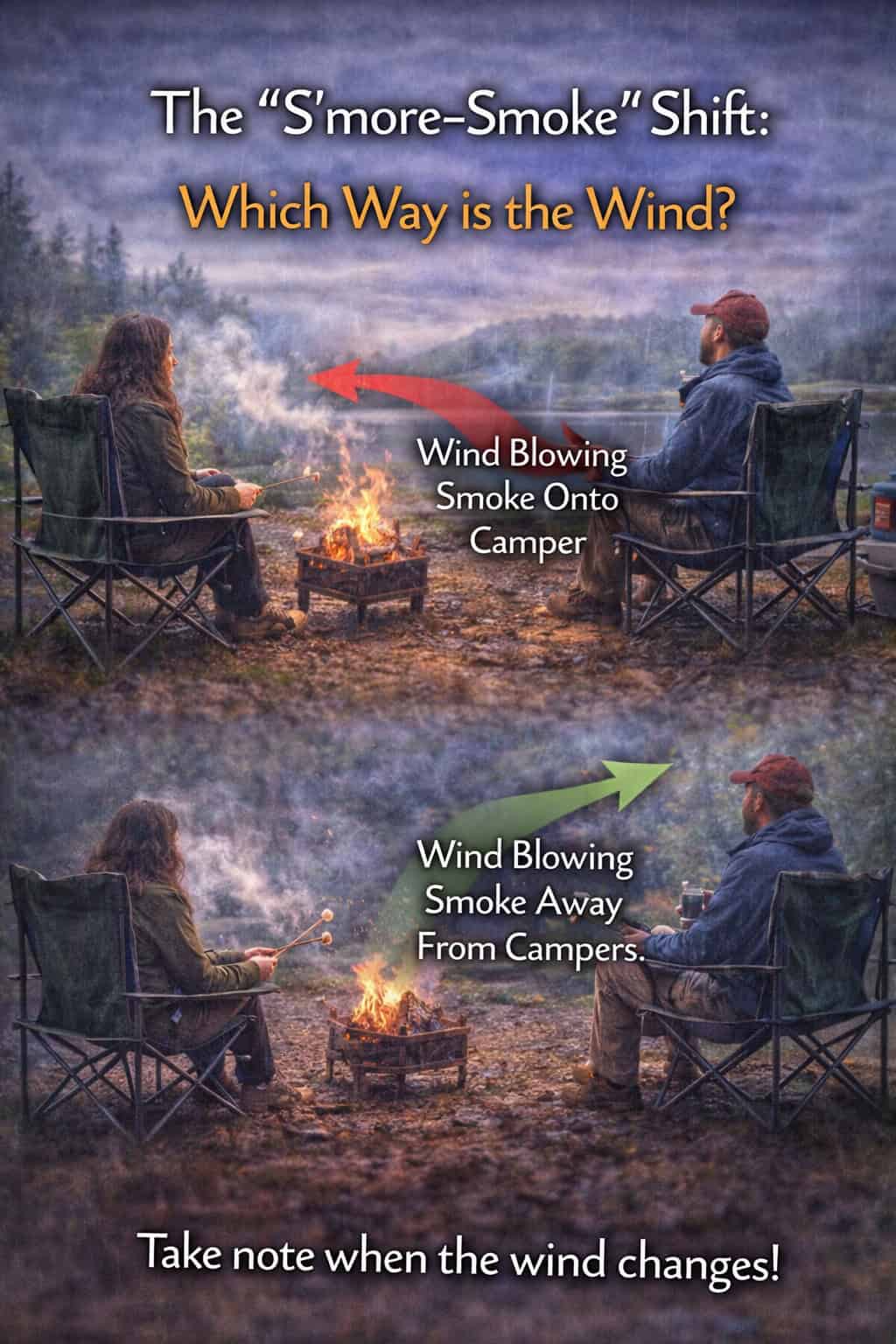
The Science of Avoiding the "Smoky Eye" Look
It never fails. You get the campfire going, you’ve got your marshmallow on a stick, and suddenly—WHOOSH—a giant cloud of thick, gray smoke hits you right in the face. You move to the other side of the fire, and ten seconds later, the smoke follows you there, too!
Some people say "smoke follows beauty," but that’s just a myth. It’s actually Airflow Physics. As a Smart Scout, you can use the wind to make sure your s’mores taste like chocolate and graham crackers, not campfire ash.
1. The "Wind Shadow" (The Science of the Follow)
Why does the smoke seem to follow you around the fire? It’s because your body is acting like a Windbreak.
-
The Physics: As the fire burns, it heats up the air. Hot air rises, and cool air rushes in from the sides to take its place.
-
The "Vacuum" Effect: When you stand right next to the fire, you block that cool air. This creates a tiny "Low-Pressure Zone" (like a little vacuum) between you and the flames.
-
The Result: The smoke gets "sucked" into that empty space right where you are standing. You are literally pulling the smoke toward your own face!
2. The "Upwind" Advantage
In March, the spring breezes are usually pretty steady. To have a fun night, you need to know which way the "Lion" is blowing.
-
The Scout Secret: Look for the Prevailing Wind. This is the direction the wind blows most of the time.
-
The Visual Hunt: Use CampgroundViews.com to look at the trees around a site. If all the branches on one side look "swept" or leaning, that’s the way the wind usually goes.
-
The Strategy: You want to sit "Upwind" of the fire. This means the wind hits your back first, then the fire, then carries the smoke away into the woods.
3. The "RV Chimney" Trap
The worst thing you can do is park your RV in a spot where the wind blows the smoke directly into your open windows or your screen door.
-
The Physics: An RV is like a giant wall. If the wind blows the smoke against the side of your rig, the smoke will "crawl" up the wall and look for any way to get inside—like your roof vents or bedroom windows.
-
The Scout Strategy: Use the 360-degree tour to see where the Fire Pit is located on the site.
-
The Goal: Pick a site where the fire pit is "Downwind" from the RV. You want the smoke to head toward the empty forest, not toward your pillow!
4. The "Spring-Breeze" Shield
If the wind is too strong in March, your campfire might turn into a "Spark Thrower," which can be dangerous.
-
The Strategy: Look for sites with a Natural Shield.
-
The Visual Hunt: Find a fire pit that is tucked behind a large boulder or a thick row of bushes. These objects break up the wind so the fire stays "calm" and the smoke goes straight up into the air instead of sideways into your lap.
Pro Tip: The "Morning-After" Check. Even a tiny bit of smoke can be annoying. Before you go to bed, make sure you "Drown, Stir, and Feel" your fire. If it’s still smoking in the morning, the wind will carry that smell right into your RV while you’re trying to eat breakfast!
Final Thoughts
Camping is all about the campfire, but it’s a lot more fun when you aren't crying from the smoke. By understanding the "Wind Shadow" and picking a site where the breeze is on your side, you can be the master of the "S'more-Smoke" shift.
Happy Roasting, Captain!
🐟 Want to find a site with the perfect Fire Pit? Don't guess where the smoke will go! CampgroundViews.com lets you virtually "Stand" at the fire pit so you can see exactly where it is in relation to your RV and the wind. Find the "Smoke-Free" gems before you light the first match.
Find your "Perfect-Pit" site at CampgroundViews.com!