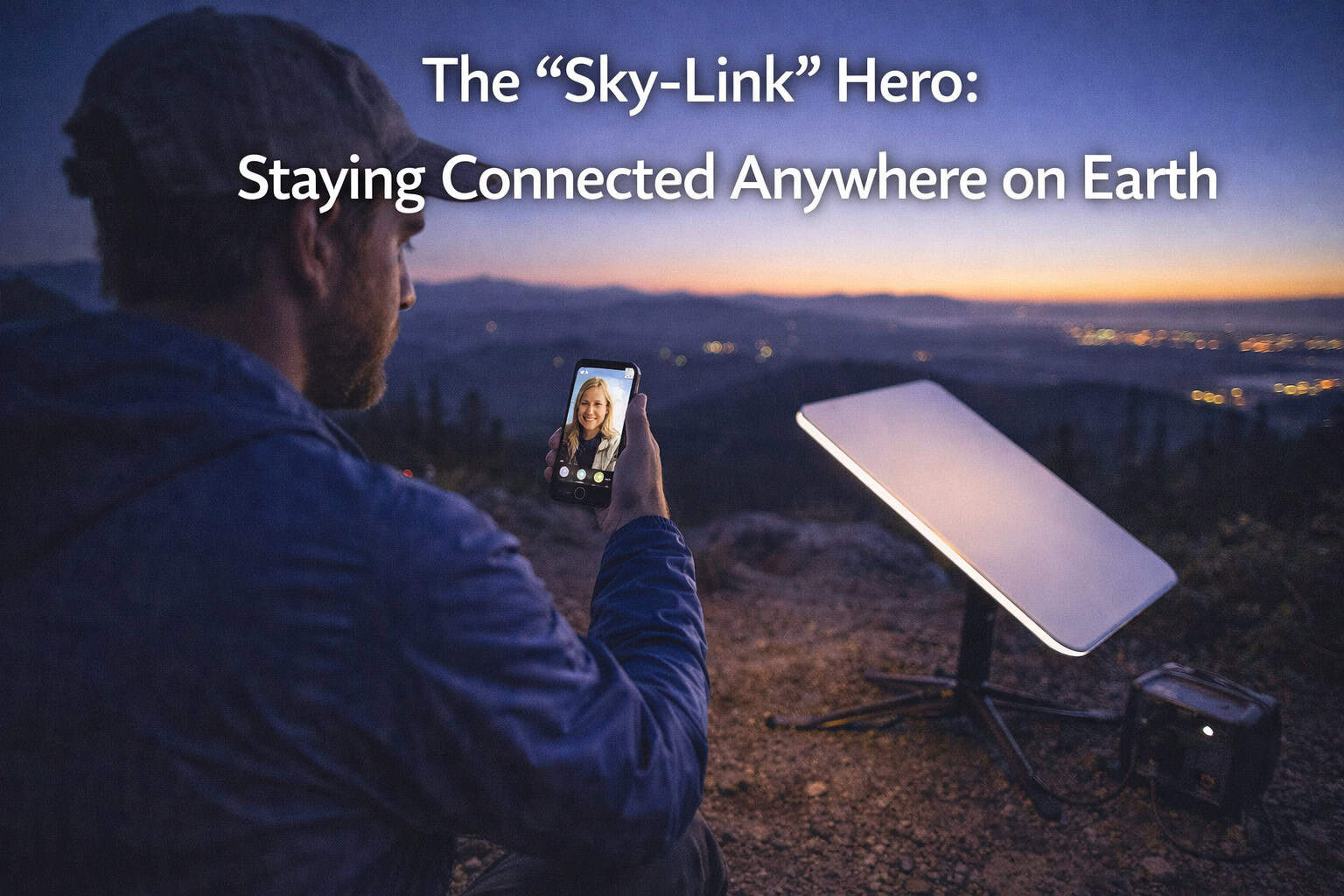
For decades, "getting away from it all" meant exactly that. You drove until the bars on your phone vanished, and for better or worse, you were officially off the map. If your car broke down or an emergency happened back home, you were relying on luck and the kindness of strangers.
But it’s 2026, and the "Dead Zones" are shrinking. Between the massive expansion of satellite constellations like Starlink and the integration of satellite SOS in almost every modern smartphone, we are entering the era of the Sky-Link Hero. Being a "Hero" doesn't mean you’re scrolling TikTok in a canyon; it means you have the power to choose when and where you connect, turning the entire planet into your potential office—or your safety net.
1. The Death of the "Dead Zone"
The biggest shift in the last few years isn't just that satellite internet exists; it’s that it’s become portable and painless. In the past, you needed a fixed dish and a professional installer. Now, a "Sky-Link" setup can be as small as a tablet and powered by a portable battery (like the ones in your Sun-Powered Kitchen). Whether you’re in the middle of the Mojave or deep in the North Woods, the sky is now your router.
Why This is a Game-Changer:
-
The "Work-From-Woods" Reality: You can attend a Zoom call from a picnic table with 100Mbps speeds, then spend the afternoon hiking.
-
Real-Time Weather Updates: No more guessing if that dark cloud is a drizzle or a flash-flood warning.
-
The Ultimate Safety Net: Satellite-to-cell technology means even without a dedicated dish, your phone can send an SOS or a "check-in" text from anywhere on Earth.
2. The Golden Rule: Connection is a Tool, Not a Tether
Here’s the candid truth: Just because you can connect anywhere doesn't mean you should connect everywhere. The "Sky-Link" Hero knows how to use technology to enhance their freedom, not restrict it.
The Golden Rule of Modern Camping: > Use the satellite to enable your adventure, not to distract from it. Connect to download the map; disconnect to walk the trail. Connect to send the "I'm safe" text; disconnect to eat dinner by the fire.
3. High-Tech Prep: Is the Sky "Open"?
If you're relying on satellite tech—whether for a critical work day or just peace of mind—there is one physical limitation that even 2026 tech hasn't fully beaten: Obstructions. If you're parked under a thick canopy of 100-foot pines, your "Sky-Link" hero becomes a "No-Signal" zero. Satellite dishes need a clear, unobstructed view of the northern (or southern) sky to maintain a stable high-speed connection.
| Situation | Connection Strategy | Potential Obstruction |
| Deep Forest | Low (Good for "Ghost Mode") | Heavy Canopy/Trees |
| Canyon Floor | Intermittent | Rock Walls/High Ridges |
| Alpine Meadow | Peak Performance | None (Perfect for Remote Work) |
| Lakeside | High | Usually Clear Sky Access |
Don't Guess Your Connection—Scout Your Sky
If you’re planning a "Work-From-Camp" week or just want to ensure your satellite SOS has a clear path to the stars, you can’t rely on a flat map. You need to see the trees.
Before you book your site, use CampgroundViews to virtually stand in the campsite. Their 360-degree virtual tours allow you to look up. You can see exactly where the trees are, find the sites with the clearest views of the sky, and ensure your "Sky-Link" setup has the line-of-sight it needs to keep you connected.
Click here to find your high-speed sanctuary with the Best Camping Tool Ever!