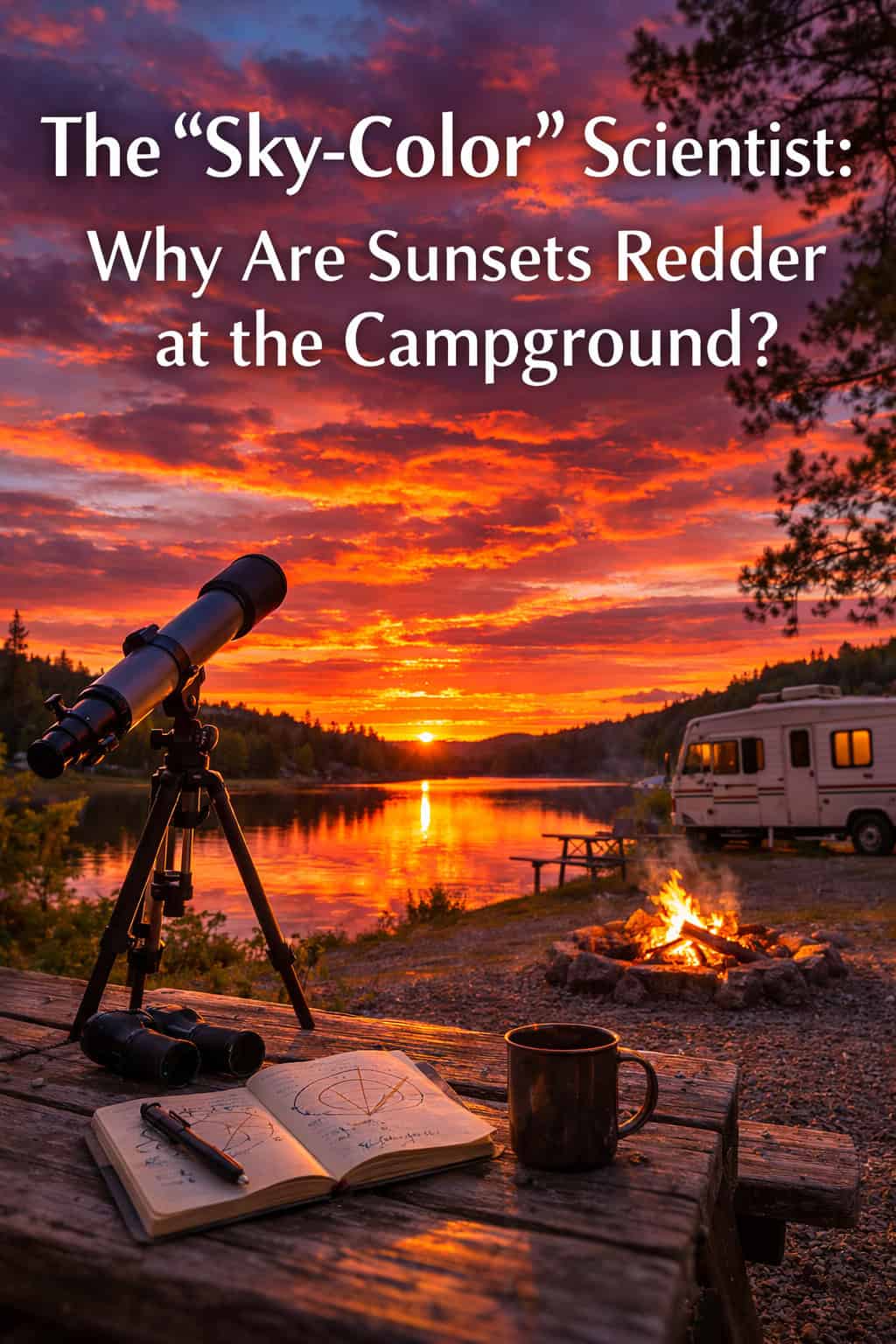
The Physics of the "Golden Hour" Glow
You’re sitting by the campfire, roasting a marshmallow, when you look up and see it: the sky is exploding in deep oranges, fiery reds, and soft purples. It feels way more intense than the sunsets you see back home in the city.
Is it just because you're more relaxed? Maybe. But there is actually Atmospheric Physics at play. As a Sky-Color Scientist, your job is to understand why the "Campground Glow" is so much more spectacular.
1. The "Long Way Home" (Rayleigh Scattering)
The Science: Light from the sun looks white, but it’s actually made of all the colors of the rainbow (Red, Orange, Yellow, Green, Blue, Indigo, Violet).
-
The Physics: When sunlight hits the Earth’s atmosphere, it bumps into gas molecules and scatters. Blue light has short, choppy waves, so it scatters easily—that’s why the sky is blue during the day!
-
The Sunset Shift: At sunset, the sun is low on the horizon. The light has to travel through much more of the Earth's atmosphere to reach your eyes than it does at noon.
-
The Result: By the time the light gets to you, the blue and violet waves have been scattered away completely, leaving only the long, lazy Red and Orange waves to reach your eyes.
2. The "Campground Filter" (Aerosols)
The Science: In the city, the air is full of "Big" pollution (like car exhaust). In the wilderness, the air is filled with different kinds of tiny particles called Aerosols.
-
The Ingredients: Pine pollen, dust from dirt roads, and—most importantly—smoke from campfires.
-
The Physics: These slightly larger particles are perfect for scattering even more light. They act like a "lens" that catches the red light and bounces it around, making the whole sky look like it’s glowing.
-
The Secret: A little bit of campfire smoke in the air actually makes the sunset look better because it provides more "canvas" for the red light to hit!
3. The "Low Horizon" Trick
The Problem: In the city, buildings and trees block the "True Horizon." You only see the sunset when the sun is already halfway down.
-
The Advantage: At a lakefront or mountain campground, you have a wide-open view.
-
The Science: This allows you to see the "Belt of Venus." Look away from the sunset, toward the East. You might see a pinkish glow sitting on top of a dark blue shadow. That blue part is actually the Shadow of the Earth being projected into the sky!
4. Clouds: The "Projector Screens"
The Science: Not all clouds are the same. High-altitude clouds (like Cirrus) are made of ice crystals.
-
The Physics: These ice crystals act like tiny prisms. When the sun is below the horizon, it can still "hit" these high clouds from underneath.
-
The Magic: Because the sun is shining up at them, they turn bright neon pink or orange long after the ground has gone dark. It’s like a movie being projected onto a giant white screen in the sky.
5. The "Post-Sunset" Blue Hour
The Science: Don't go inside as soon as the sun disappears!
-
The Physics: About 15 minutes after sunset, you enter the "Blue Hour." The red light is gone, but the upper atmosphere is still catching enough sunlight to create a deep, royal blue glow.
-
The Mission: This is the best time for "Blue Hour" photography. Everything looks peaceful and magical, and the campfire will look even brighter against the deep blue sky.
Pro Tip: The "Clean Air" Myth. People think "clean air" makes better sunsets, but it’s actually the opposite! A perfectly clean sky usually results in a pale yellow sunset. You want a little bit of dust, salt spray (if you’re near the ocean), or forest "haze" to get those deep, "Instagram-worthy" purples and reds.
Final Thoughts
The next time you see a spectacular campground sunset, remember that you are watching a live physics experiment. The Earth is spinning, the atmosphere is filtering, and the campfire smoke is helping to paint the sky. It’s a masterpiece that only happens when all the "variables" are just right.
Enjoy the show, Scientist!
🐟 Want to find a site with the "Best Seat in the House" for sunset? You need a site that faces West with no obstructions! CampgroundViews.com lets you take a 360-degree tour of the park. You can check the "Compass" on the map and look at the view from each site to make sure you have a front-row seat for the "Golden Hour."
Scout your sunset at CampgroundViews.com!