The Science of Staying Dry (Even When It Pours)
It’s raining, it’s pouring... and everyone is bored! When it rains during a camping trip, your RV starts to feel very small, very fast. It’s like being stuck in a giant toaster with your whole family and a wet dog.
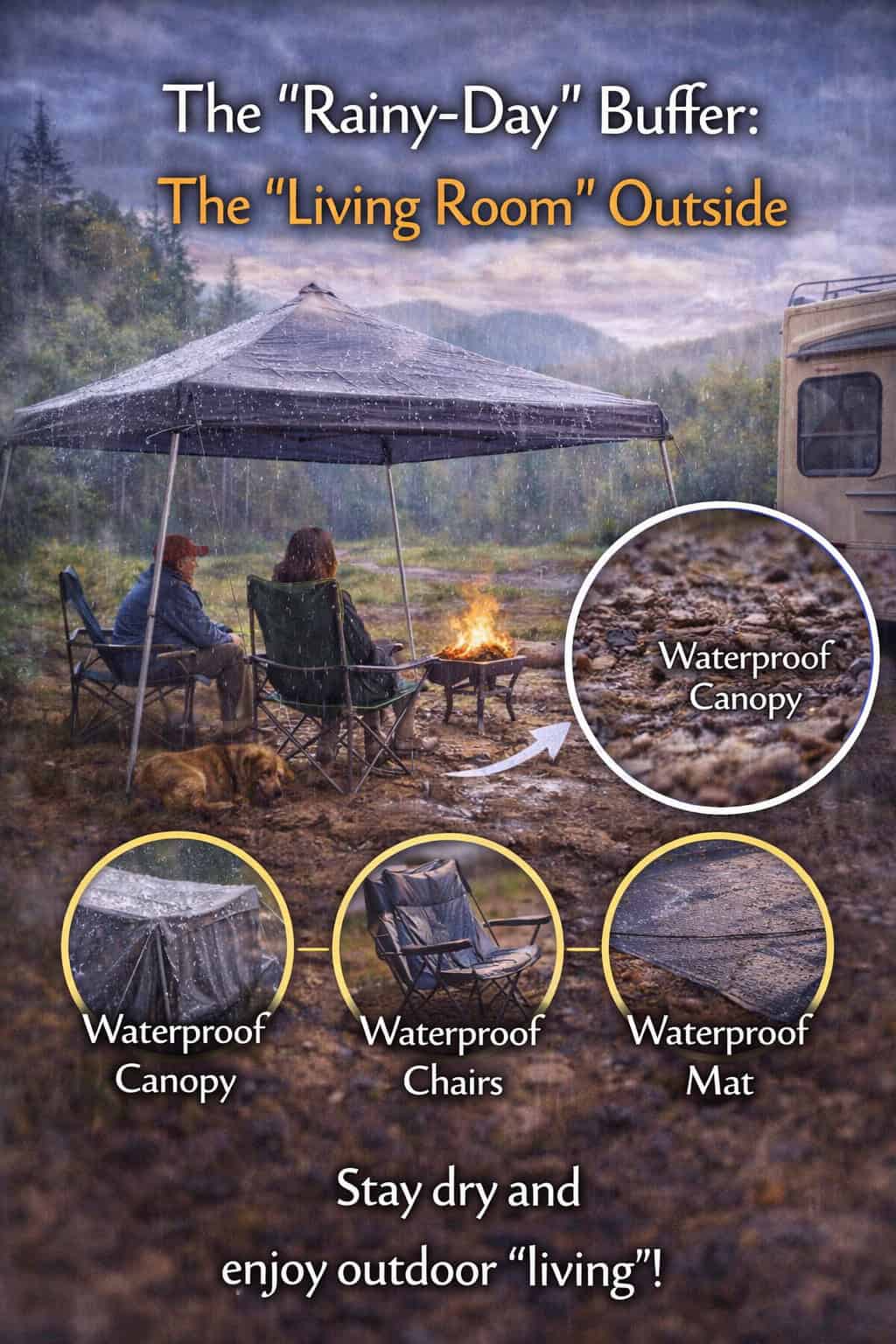
But a Smart Scout knows a secret: your "Living Room" isn't just inside the RV. It’s the space right outside your door under the awning. If you pick the right site, you can still hang out "outside" without getting your socks soaked. Here is how to find the perfect "Rainy-Day Buffer."
1. The "Bowl" vs. The "Hump" (Topography)
Water is lazy. It always takes the easiest path, which is Downhill.
-
The Science: If your campsite is shaped like a "bowl" (lower in the middle), every drop of rain from the whole park will travel to your site to say hello.
-
The Physics: You want a site that is a "Hump." This means the parking pad is slightly higher than the ground around it.
-
The Result: When the rain hits a "Hump" site, it rolls off the sides and into the grass, leaving your "outdoor living room" nice and dry.
2. The "Surface Science" (Gravel is King)
In March, the ground is already soft from the winter melt. Adding rain makes it even messier.
-
The Drain Factor: Grass and dirt act like a sponge—they hold onto water. This creates mud that sticks to your shoes and gets tracked all over the RV.
-
The Gravel Hack: Gravel is like a "Secret Drainage System." Because there are tiny gaps between the stones, the rainwater slips right through and disappears into the ground.
-
The Visual Hunt: Use CampgroundViews.com to look at the ground under the awning area. If you see clean, thick gravel, that’s a "Dry-Feet Site." If you see patchy grass and dark dirt, it’s a "Mud-Zone."
3. The "Awning Shield" (Protection Geometry)
Your awning is your best friend on a rainy day, but it needs a little help from the wind.
-
The Wind-Rain Math: Rain doesn't always fall straight down. If the wind is blowing, the rain falls at an Angle.
-
The Strategy: Use the 360-degree tour to find a site with Trees or a Hill on the side where the wind usually blows.
-
The Goal: If the trees block the wind, the rain will fall straight down, and your awning will keep your picnic table perfectly dry. If there's no windbreak, the rain will blow right under your awning and soak your chairs!
4. The "Step-Out" Zone
The most important part of your site is the 3 feet right in front of your RV steps.
-
The Scout Secret: Look for a site with a Concrete or Paved "Patio" area.
-
The Benefit: Having a hard surface to step onto means you can take off your muddy boots and leave them outside without them sinking into the earth. It keeps the "Inside" of your home clean and the "Outside" of your home usable.
Pro Tip: The "Corner Drop." If you use your awning in the rain, always tip one corner of the awning lower than the other. This creates a "Water Slide" so the rain runs off the side. If you leave it flat, the water will pool in the middle until the weight gets so heavy it breaks the metal arms!
Final Thoughts
A little rain doesn't have to ruin the fun. By using your scouting skills to find the "High Ground" and the gravel pads, you can give your family an extra 100 square feet of "Living Room" to play games, read books, or just listen to the rain—without getting wet.
Stay dry, Captain!
🐟 Want to find a "High-and-Dry" site? Don't get stuck in a puddle! CampgroundViews.com lets you virtually "Walk" the site so you can see the slope of the ground and the surface of the pad. Find the "Gravel Gems" and the "Hump Sites" before the clouds move in.
Find your "Rain-Ready" sanctuary at CampgroundViews.com!