Finding the Hidden "Ice Boxes" of the Campground
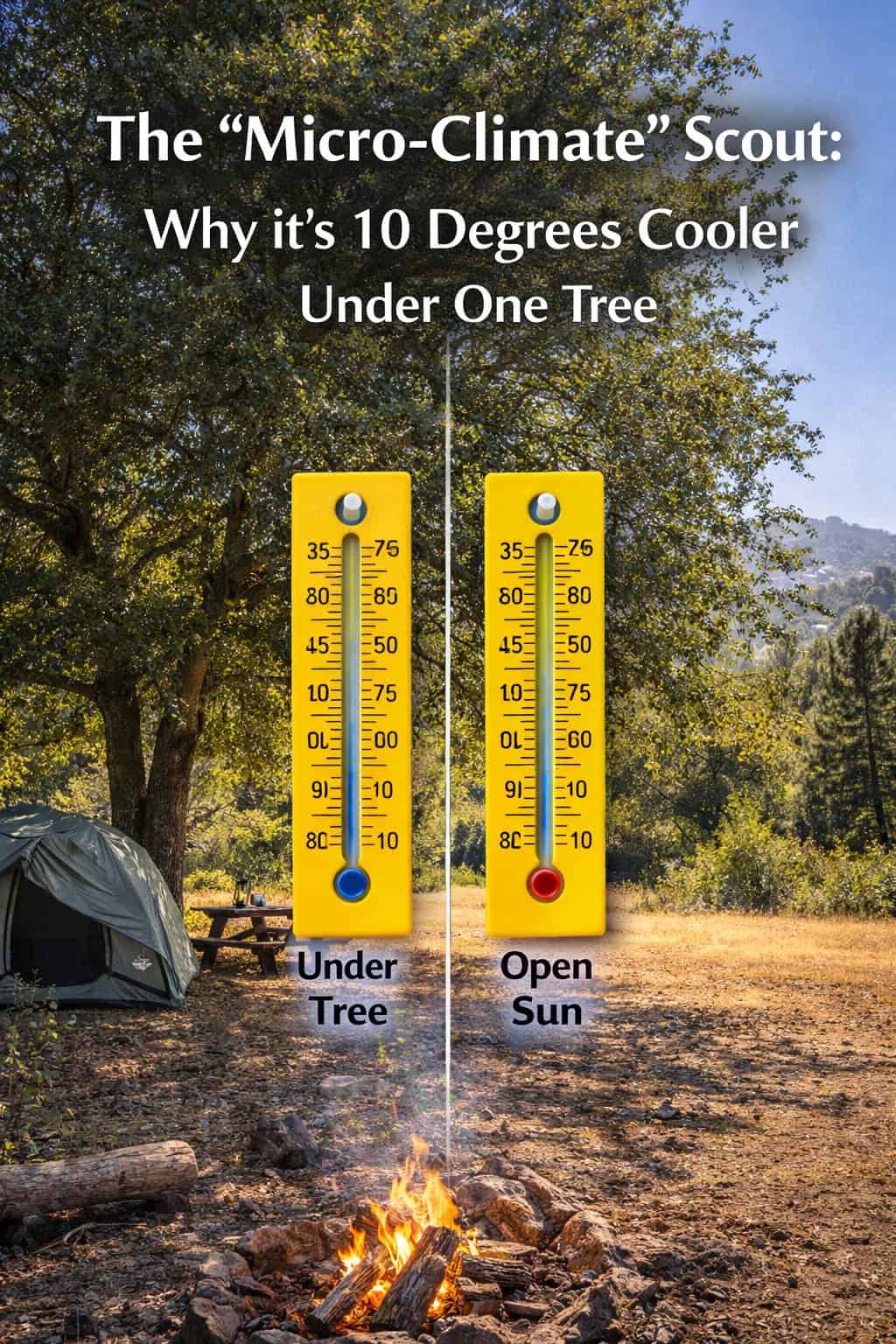
It’s a scorching summer afternoon. You’re walking across the campground asphalt, and it feels like you’re standing on a giant frying pan. But then, you step into the shade of a specific oak tree or move toward the edge of a creek, and suddenly—whoosh—it feels like someone turned on the air conditioning.
You haven't just found shade; you’ve discovered a Micro-Climate. A micro-climate is a small area where the weather is completely different from the "official" temperature on your phone. As a Micro-Climate Scout, your job is to use science to find the coolest spot in the park.
1. The "Sweating Tree" Effect (Evapotranspiration)
The Science: Trees don't just block the sun; they actually release water.
-
The Physics: Trees "breathe" out water vapor through tiny holes in their leaves called Stomata.
-
The Cooling: To turn liquid water into vapor, the tree uses up heat energy from the air. This is called Evaporative Cooling.
-
The Result: A big, leafy tree is like a giant, natural "Swamp Cooler." Standing under a tree is cooler than standing under a plastic awning because the tree is actively pumping out "cold" air!
2. The "Albedo" of the Ground
The Science: Different surfaces "soak up" or "bounce back" the sun's heat. This is called Albedo.
-
Dark Surfaces (Asphalt/Dirt): These have low albedo. They soak up the sun's energy all day and turn into "Radiators" that stay hot even after the sun goes down.
-
Light/Green Surfaces (Grass/Moss): These have high albedo (they reflect more light) and they don't hold onto heat as much.
-
The Scout Tip: If your picnic table is on a patch of green grass, it will be much cooler than a table sitting on a blacktop pad.
3. The "Cold Air Drainage" Mystery
The Science: Cold air is "heavier" (denser) than warm air.
-
The Physics: Just like water flows downhill into a lake, cold air flows down the sides of hills and mountains and "pools" in the lowest spots.
-
The Observation: If your campground is in a valley or has a "hollow," the temperature at the bottom of that hill can be 5 to 10 degrees cooler than at the top.
-
The Scout Tip: If it's a hot night, the site at the bottom of the hill is the "Premium" spot for sleeping!
[Image showing cold air drainage in a valley at night]
4. The "Thermal Mass" of Water
The Science: Water takes a long time to heat up and a long time to cool down. This is called Specific Heat Capacity.
-
The Cooling: If you are camping near a river or a lake, the water is usually much cooler than the air during the day.
-
The "Convection" Breeze: As the hot air over the land rises, it "pulls" the cool air from the surface of the water toward the shore.
-
The Result: A site within 50 feet of the water will almost always have a "Natural Fan" blowing cool air your way.
5. The "Sky-View" Factor
The Science: At night, objects lose their heat by sending it straight up into space. This is called Radiative Cooling.
-
The Physics: If you are parked directly under a thick "Canopy" of trees, the heat from the RV gets trapped by the leaves and stays warm.
-
The Strategy: If you want a cool morning, find a site that is open to the sky. As soon as the sun goes down, your RV will "dump" its heat into the cold atmosphere, making it much easier to sleep.
Pro Tip: The "Bark-Feel" Test. If you want to find the "Coolest" tree, put your hand on the bark. A tree with smooth, light-colored bark (like a Birch or Aspen) reflects more sun and will feel much cooler to the touch than a rough, dark Oak. The cooler the tree, the cooler the air around it!
Final Thoughts
Being a Micro-Climate Scout means you don't have to hide in the RV with the AC on all day. By understanding how water, wind, and shade work together, you can find the "Secret Ice Boxes" of the campground and stay comfortable while everyone else is melting.
Stay cool, Scout!
🐟 Want to find a site in the "Coolest" micro-climate? You can scout the shade and the water features before you book! CampgroundViews.com lets you take a 360-degree tour of the park. You can see which sites have the thickest "Sweating Tree" canopies and which ones are perfectly positioned to catch the "Lake Breeze."
Find your "Chill Zone" at CampgroundViews.com!