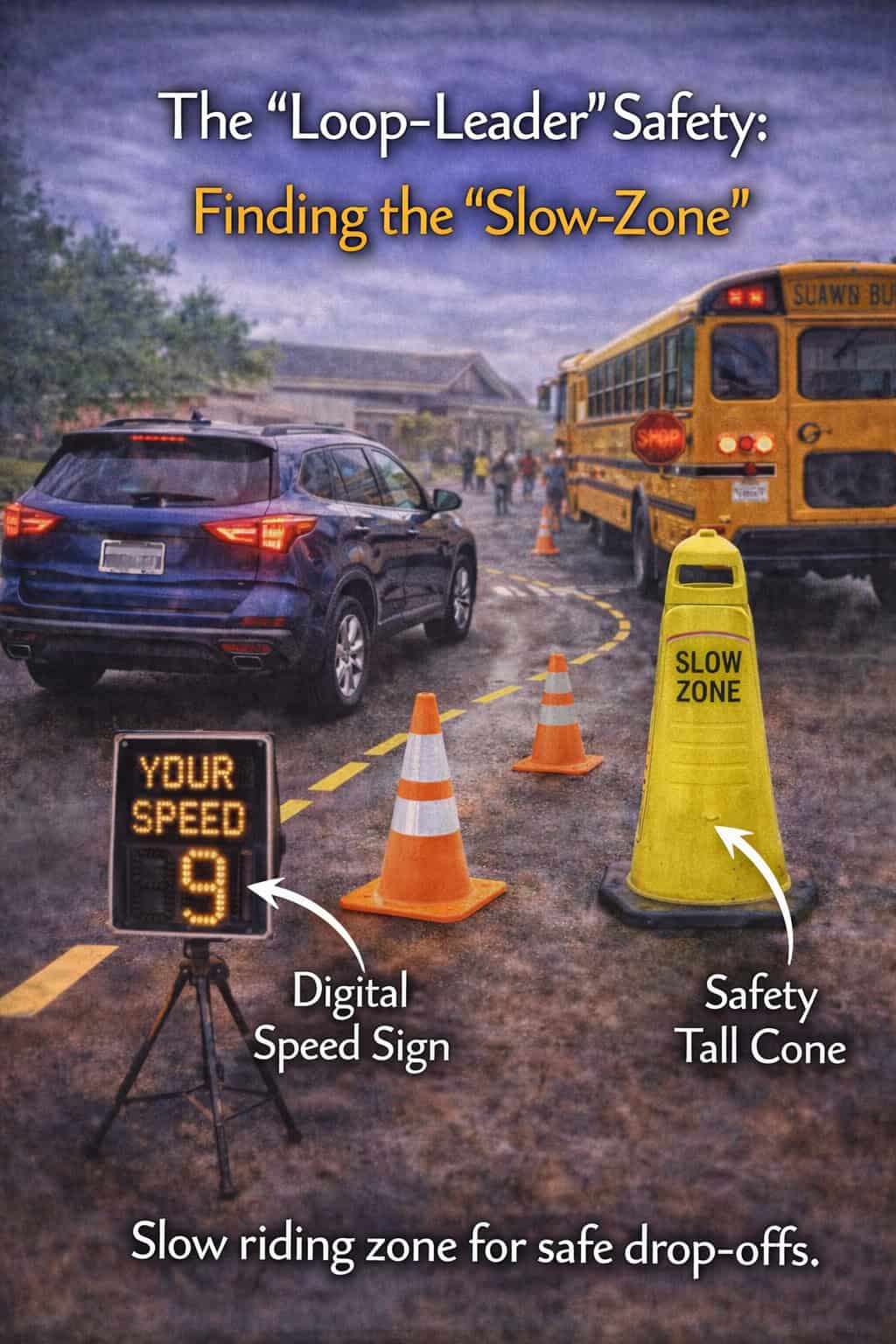
The Physics of Traffic and Tiny Bikes
If you have kids, the campground "loop" isn't just a road—it’s a racetrack, a bike path, and a sidewalk all in one. But not every loop is a safe place to ride. Some roads feel like a quiet neighborhood, while others feel like a busy highway for 10-ton motorhomes.
As a Smart Scout, you can actually "see" how fast cars will drive before you even pull into the park. Here is how to find the "Slow-Zone" for your family’s bike leaders.
1. The "Straight-Away" Speed (Physics)
Why do cars go faster on some roads than others? It’s a simple rule of physics: Longer roads lead to faster speeds.
-
The Science: When a driver sees a long, straight stretch of pavement, they feel "safe" going faster. Their brain tells them there are no surprises coming.
-
The Math: On a straight road, the speed ($v$) tends to increase because there is no "friction" or change in direction to slow the driver down.
-
The Scout Strategy: Use CampgroundViews.com to look for sites on Curves.
2. The "Cul-de-Sac" Bubble
In a regular neighborhood, the "Cul-de-Sac" (the dead-end circle) is the most popular place to live. The same is true in a campground!
-
The "Zero-Through" Rule: In a circle or a dead-end, the only cars driving there are the people who actually stay there.
-
The Physics of Flow: A main loop has "Through-Traffic"—everyone uses it to get to the pool, the store, or the exit. A cul-de-sac is a "Bubble" where the traffic flow drops to almost zero.
-
The Visual Hunt: Look for sites at the very end of a road or in a small "hook" off the main loop.
3. The "Blind-Curve" Caution
While you want cars to drive slowly, you also want them to see you.
-
The Science: This is called Sight-Line Physics. If a site is on a very sharp corner with thick bushes, a driver might not see a kid on a bike until they are very close.
-
The Scout Strategy: Use the 360-degree tour to "Drive" past your site.
-
The Test: Can you see the "Living Area" of the site from a distance? You want a site that makes drivers slow down for a curve but still gives them a "Clear View" of the road ahead.
4. The "Pedestrian-Path" Buffer
The safest site is one that has a "Secret Path" that doesn't use the road at all.
-
The Strategy: Look for sites that back up to a Walking Trail or a playground path.
-
The Benefit: If your kids can ride their bikes through the grass or on a gravel path directly to the playground, they never have to worry about "Traffic-Flow" at all!
-
The Visual Hunt: Use the virtual tour to look behind the sites. Is there a gap in the trees? Is there a mowed path? That’s your "Safety Shortcut."
Pro Tip: The "Bike-Flag" Hack. Since RVs have giant "Blind Spots," it can be hard for a driver to see a small child on a bike. Adding a tall, bright orange safety flag to a kid's bike or scooter makes them visible even if they are behind a parked truck or a bush!
Final Thoughts
Finding the "Slow-Zone" is all about picking the right Geometry. By avoiding the long "Straight-Aways" and finding the "Cul-de-Sac Bubbles," you can let your kids lead the loop with confidence.
Ride safe, Captain!
🐟 Want to find a "Slow-Zone" site? Don't guess which roads are busy! CampgroundViews.com lets you virtually "Drive the Loop" so you can see the turns, the dead-ends, and the sight lines for yourself. Find the "Quiet-Corner" gems before the kids even grab their helmets.
Find your "Safety-First" site at CampgroundViews.com!