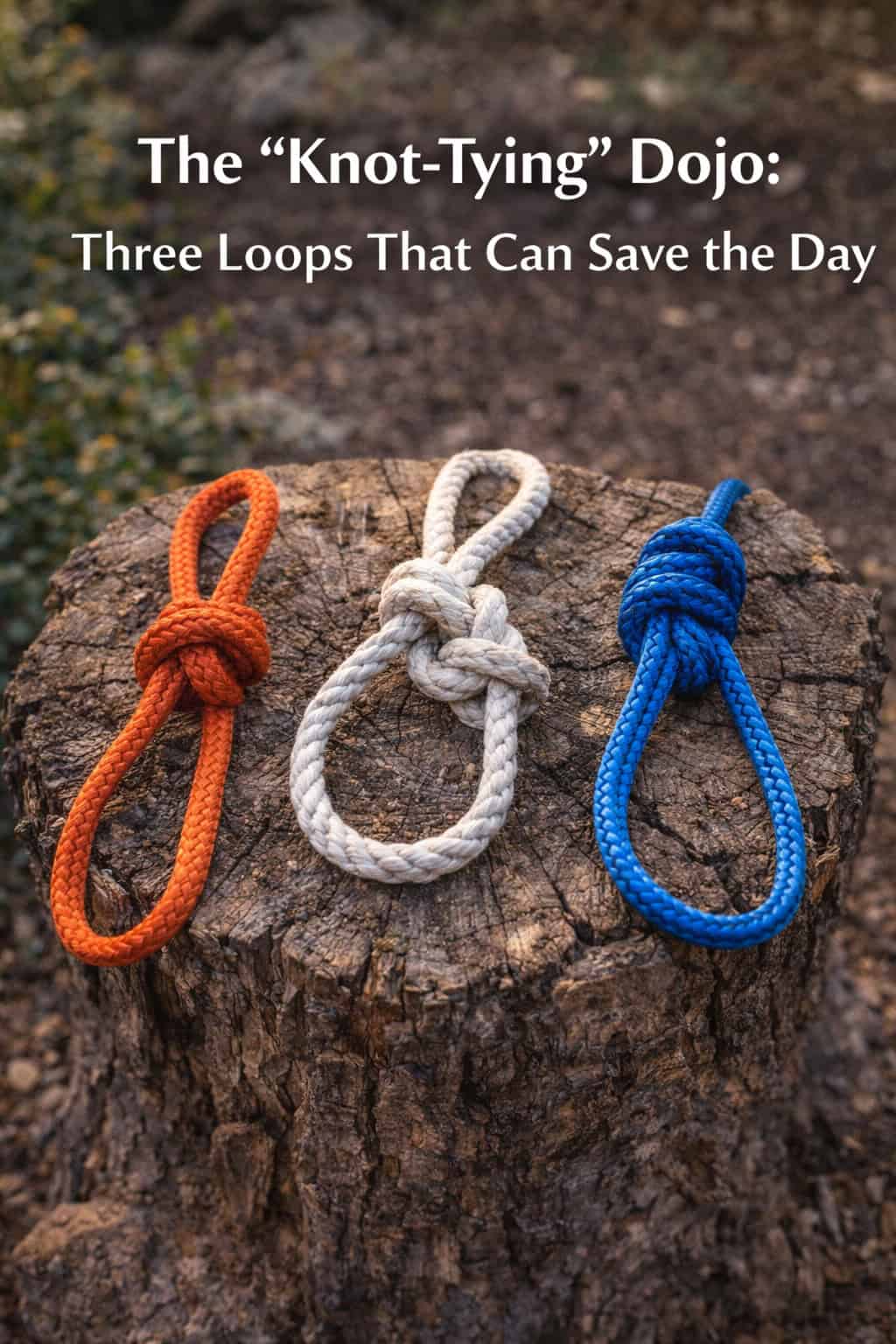
How to Master the "String Science" of the Great Outdoors
There are thousands of different knots in the world—knots for sailing, knots for climbing, and knots that look like fancy Celtic braids. But as a Co-Captain, you don't need to be a human spider. You just need to master three specific loops.
Knot-tying isn't just about "twisting string"; it’s a lesson in Mechanical Advantage and Friction. If you learn these three, you can fix a sagging awning, hang a lantern, or even help tow a stuck wagon. Welcome to the Dojo.
1. The Bowline: The "King of Knots"
The Science: The Bowline is a "Fixed Loop." This means no matter how hard you pull on the rope, the loop will never get smaller or "choke" the object it's around.
-
The Physics: The harder you pull, the more the knot "locks" itself together. It’s incredibly strong, yet it’s famous for being easy to untie even after it has held a heavy load.
-
The "Rabbit" Story (How to Tie):
-
Make a small "hole" (a loop) in the rope.
-
The "Rabbit" (the end of the rope) comes up out of the hole.
-
The Rabbit goes around the "Tree" (the long part of the rope).
-
The Rabbit goes back down into the hole.
-
-
The Use Case: Tying a rope to a tree to hang a hammock or securing a boat to a dock.
2. The Taut-Line Hitch: The "Slide-and-Lock"
The Science: This is a Friction Hitch. It is a "Magical" knot because you can slide it up and down the rope to make it tighter or looser, but as soon as you let go, it "bites" the rope and stays put.
-
The Physics: The secret is in the multiple internal wraps. When the rope is pulled tight, the friction of the wraps against the main line prevents it from slipping.
-
The Use Case: This is the #1 knot for Tent Guy-Lines. If your awning starts to sag in the wind, you just slide the knot to tighten it. No need to untie and redo the whole thing!
3. The Square Knot: The "Joiner"
The Science: This is a "Binding Knot." It is designed to join two separate pieces of rope together into one long line.
-
-
The Physics: It relies on the ropes "weaving" through each other so that they push against one another.
-
The Rule: "Left over Right, then Right over Left."
-
The Warning: A Square Knot is only for ropes of the same thickness. If you try to join a tiny string to a thick rope, it will slip!
-
The Use Case: Tying a bundle of firewood together or extending a clothesline so it reaches the next tree.
-
4. The "Dojo" Practice Drill
To become a Master, you must practice Muscle Memory.
-
The Challenge: Sit in the passenger seat of the RV with a 3-foot piece of practice rope.
-
The Goal: Can you tie a Bowline with your eyes closed?
-
The Science: When you can tie a knot without looking, your brain has moved the instructions from your "Thinking Brain" to your "Doing Brain." This is how real explorers handle emergencies in the dark!
5. The "Rope-Safety" Code
-
Check for Chafing: If a rope looks "fuzzy," it’s losing its strength. Don't use a fuzzy rope for anything heavy!
-
Heat is the Enemy: Never let two ropes "rub" against each other quickly (like when sliding down a line). The friction creates heat that can actually melt synthetic ropes (like nylon).
Pro Tip: The "Fuser" Trick. Most modern camping ropes are made of plastic (nylon or polyester). If the end of your rope is fraying, ask an adult to use a lighter to "melt" the end into a solid plastic cap. It’s like a permanent "aglet" (the tip of a shoelace) for your gear!
Final Thoughts
A piece of rope is just a string until a Co-Captain adds a knot. Suddenly, it becomes a tool, a bridge, or a safety line. Mastering the Bowline, the Taut-Line, and the Square Knot gives you "Superpowers" over the physical world.
Master the loops, master the camp!
🐟 Want to find a site with the perfect "Anchor Trees" for your knots? You need strong, healthy trees that are spaced just right! CampgroundViews.com lets you take a 360-degree tour of the park. You can look at the trees in each site to see if they are the right size for hanging a gear line or practicing your new Taut-Line Hitches.
Scout your "Anchors" at CampgroundViews.com!