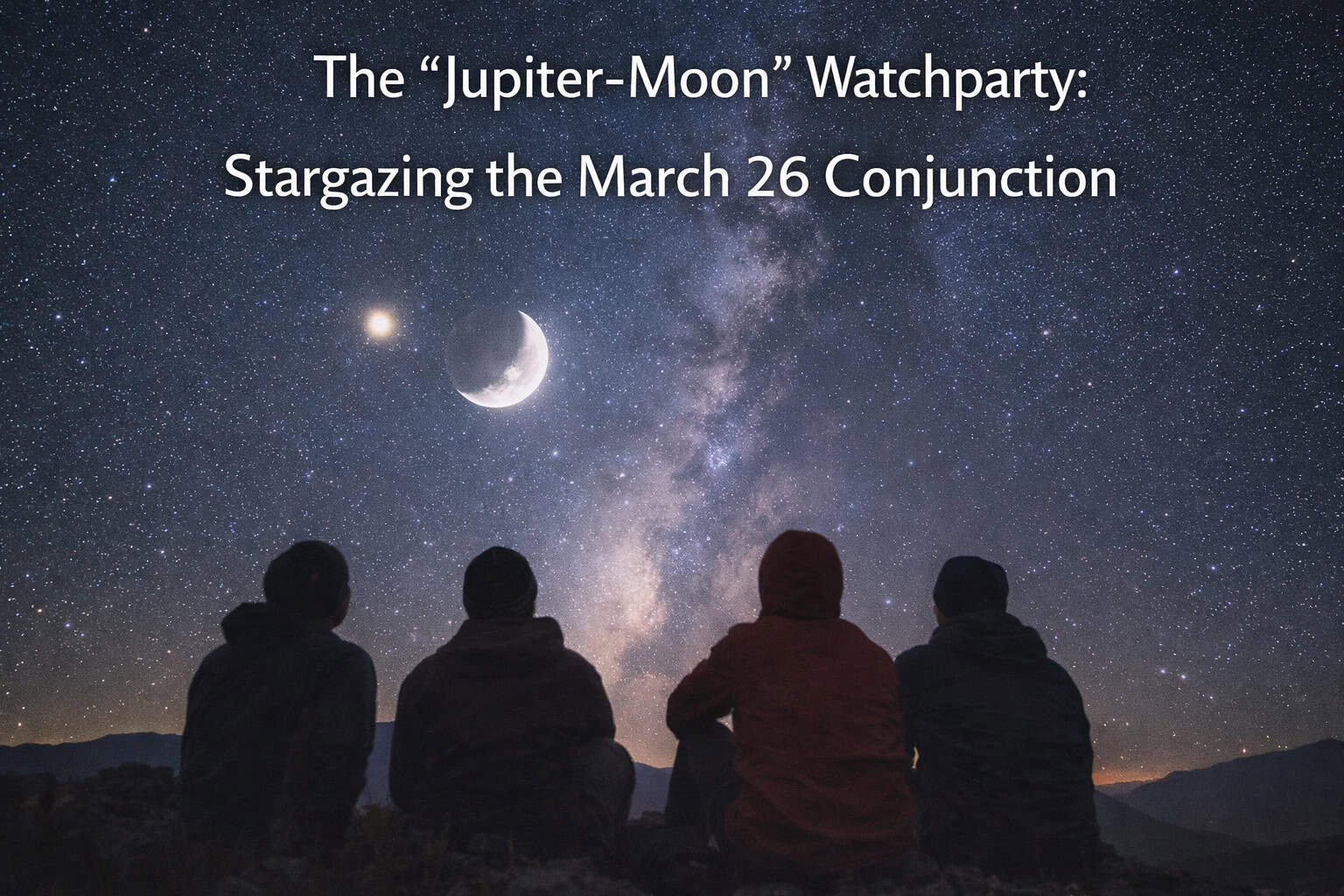
If you looked up at the night sky yesterday, March 26, you probably noticed something spectacular: a brilliant, unblinking "star" hanging right next to the glowing curve of the Moon.
That wasn't a star. That was Jupiter, the king of the planets, making a "close approach" to our lunar neighbor in the constellation Gemini. Even though we are technically on the tail end of the peak conjunction (today is Friday, March 27), the show isn't over. In fact, for many "Sky-Link" heroes, tonight offers an even better opportunity to see these two cosmic giants as they begin to drift apart in a slow, graceful arc across the spring sky.
1. The Science of the "Dance"
In astronomical terms, a conjunction happens when two celestial bodies share the same right ascension or ecliptic longitude. On March 26, the Moon and Jupiter were separated by only a few degrees of arc.
Tonight, the Moon has moved roughly $13^\circ$ further along its orbit, but the pairing remains the brightest feature in the night sky.
-
The Moon: A bright waxing gibbous (approx. 70-75% illuminated).
-
Jupiter: Shining at a staggering magnitude of roughly $m \approx -2.1$, making it nearly $20\times$ brighter than Sirius, the brightest star in the sky.
2. Capturing the Glow: 2026 Smartphone Tips
You don't need a $2,000$ telescope to be a "Sky-Link" Hero. With the sensor technology available in 2026, your phone can capture the Moons of Jupiter—if you know the tricks.
-
Lock the Exposure: Tap on the Moon on your screen, then slide the brightness (exposure) bar down. If you don't, the Moon will look like a glowing white blob and Jupiter will vanish in the glare.
-
The "Stable-Scout" Hack: Prop your phone against a rock or a fence post. Even a $0.5\text{-second}$ exposure can reveal the four Galilean moons (Io, Europa, Ganymede, and Callisto) as tiny pinpricks of light.
-
Night Mode vs. Pro Mode: If your phone has a "Pro" or "Manual" mode, set your ISO to $400$ and your shutter speed to $1/10\text{s}$. This captures the planetary detail without the digital "noise" of automatic night modes.
3. The "Dead-Battery" Connection
There is a reason we call this a "Watchparty." Stargazing is the ultimate antidote to the "digital exhaust" of our daily lives. When you are looking at light that took 43 minutes to travel from Jupiter to your eyes, that urgent email from 43 minutes ago starts to feel a lot less important.
Taking a "Dead-Battery" night to focus on the Jupiter-Moon alignment isn't just a hobby; it’s a perspective shift. It forces your eyes to adjust to the dark, lowering your heart rate and preparing your brain for that "Deep-Sleep" secret we talked about earlier.
| Feature | What to Look For | Tips |
| Jupiter | Steady, golden-white light. | Unlike stars, planets don't "twinkle" because they are disks, not points. |
| The Moon | The "Terminator" line. | Look at the edge where light meets shadow; that's where craters look deepest. |
| The Castor/Pollux Twins | Two bright stars nearby. | Jupiter is currently sitting "below" these two famous stars in Gemini. |
4. Find Your "Dark-Sky" Sanctuary
The biggest enemy of a Jupiter-Moon watchparty isn't clouds; it's Light Pollution. To see the subtle colors of Jupiter and the faint stars of Gemini, you need to get away from the "Sky-Glow" of the city.
The Scout Rule: The further you are from a streetlamp, the bigger the universe gets.
Scout the Stars Before You Park
A great stargazing night can be ruined by a single bright security light from a neighboring campsite or a thick cluster of trees blocking your view of the southern sky. To be a true "Sky-Link" Hero, you need to know exactly what your "window to the universe" looks like.
Before you head out to catch the tail end of the Jupiter conjunction, use CampgroundViews to scout your site. Their 360-degree virtual tours allow you to look up and around. You can find the sites with the clearest horizons, ensure there are no bright facilities nearby to ruin your night vision, and pick the perfect spot for your tripod.
Click here to find your front-row seat to the stars with the Best Camping Tool Ever!