We live in an era of "digital exhaust." Every step we take, every scenic overlook we visit, and every campfire we light usually leaves a trail of GPS pings, geotagged photos, and "checking in" notifications. Even when we think we’re escaping into the wild, our pockets are leaking data.
"Ghost Mode" isn't just about privacy; it’s about reclaiming the mystery of the outdoors. It’s the art of disappearing from the grid so effectively that the only person who knows where you are is you (and maybe a trusted emergency contact).
If you're ready to vanish into the trees and leave the algorithm behind, here is your map to going "Ghost."
1. Scrub the "Digital Breadcrumbs"
Most of us are tracked without even trying. To enter Ghost Mode, you need to cut the tether before you even put the car in gear.
-
Kill the Geotags: Before you snap that "starting the hike" photo, go into your camera settings and disable location tags. Otherwise, you’re broadcasting the exact coordinates of your secret spot the moment you get back to a signal.
-
The "Airplane Mode" Hardline: Don't just silence your phone; sever the connection. Keeping your phone on "Search" for a signal in the woods drains your battery and creates a ping-trail.
-
Offline is the New Online: Download your maps (and your podcasts) while you’re still on your home Wi-Fi. Once you hit the trailhead, your phone should be a brick that happens to have a GPS chip—not a two-way radio.
2. Master the Analog Pivot
In Ghost Mode, your primary navigation shouldn't rely on a flickering blue dot. Relying on a screen keeps your eyes downcast; relying on a map keeps your eyes on the horizon.
-
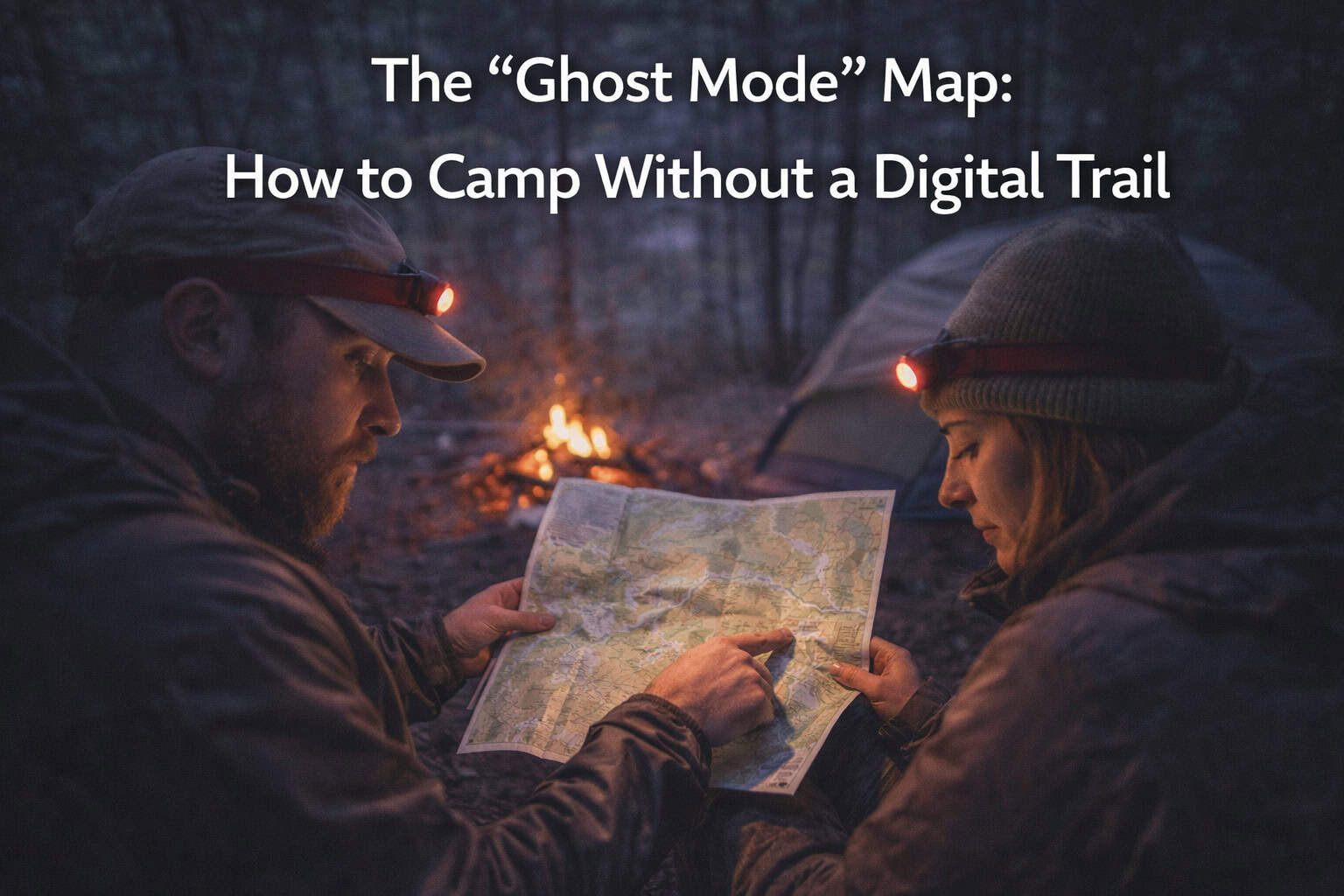
The Paper Backup: Carry a physical topographic map of the area. It doesn't need batteries, it doesn't break when dropped, and it gives you a literal "big picture" view that a 6-inch screen never can.
-
Navigate by Landmark: Practice "natural navigation." Notice the bend in the creek, the specific shape of a ridgeline, or the way the moss grows. This builds spatial intelligence—a cognitive muscle that digital GPS has allowed to atrophy.
3. Find the "True" Dead Zones
The ultimate Ghost Mode experience happens where the bars disappear naturally. In 2026, finding a place without 5G coverage is becoming a luxury.
To truly disappear, you have to seek out the topographical "shadows"—deep canyons, high mountain basins, or vast national forests where the towers can't reach. These are the places where the "twitch" to check your email is met with a liberating "No Service" message.
4. Scout the Silence Before You Go
The irony of "Ghost Mode" is that it requires excellent preparation. You can't disappear safely if you don't know where you're going. The goal is to arrive at your site with so much "visual knowledge" that you don't need to look at a screen again until you're back on the highway.
This is where you bridge the gap between high-tech planning and low-tech execution.
Pro-Tip: Use virtual scouting to ensure your "Ghost" site is actually as secluded as you hope. There's nothing worse than trying to disappear only to find you've set up camp next to a literal tour bus.
See Your Secret Spot Before You Disappear
To truly go "Ghost," you need a campsite that offers the seclusion you crave. Don't guess what your site looks like based on a tiny thumbnail.
Before you cut the cord, use CampgroundViews to take a 360-degree virtual tour of your destination. You can scout for the most private, tucked-away spots, ensuring your "Ghost Mode" experience is undisturbed by crowds or noise. Find your perfect "dead zone" and see exactly where you'll be dropping off the map.
Click here to scout your "Ghost Mode" escape with the Best Camping Tool Ever!