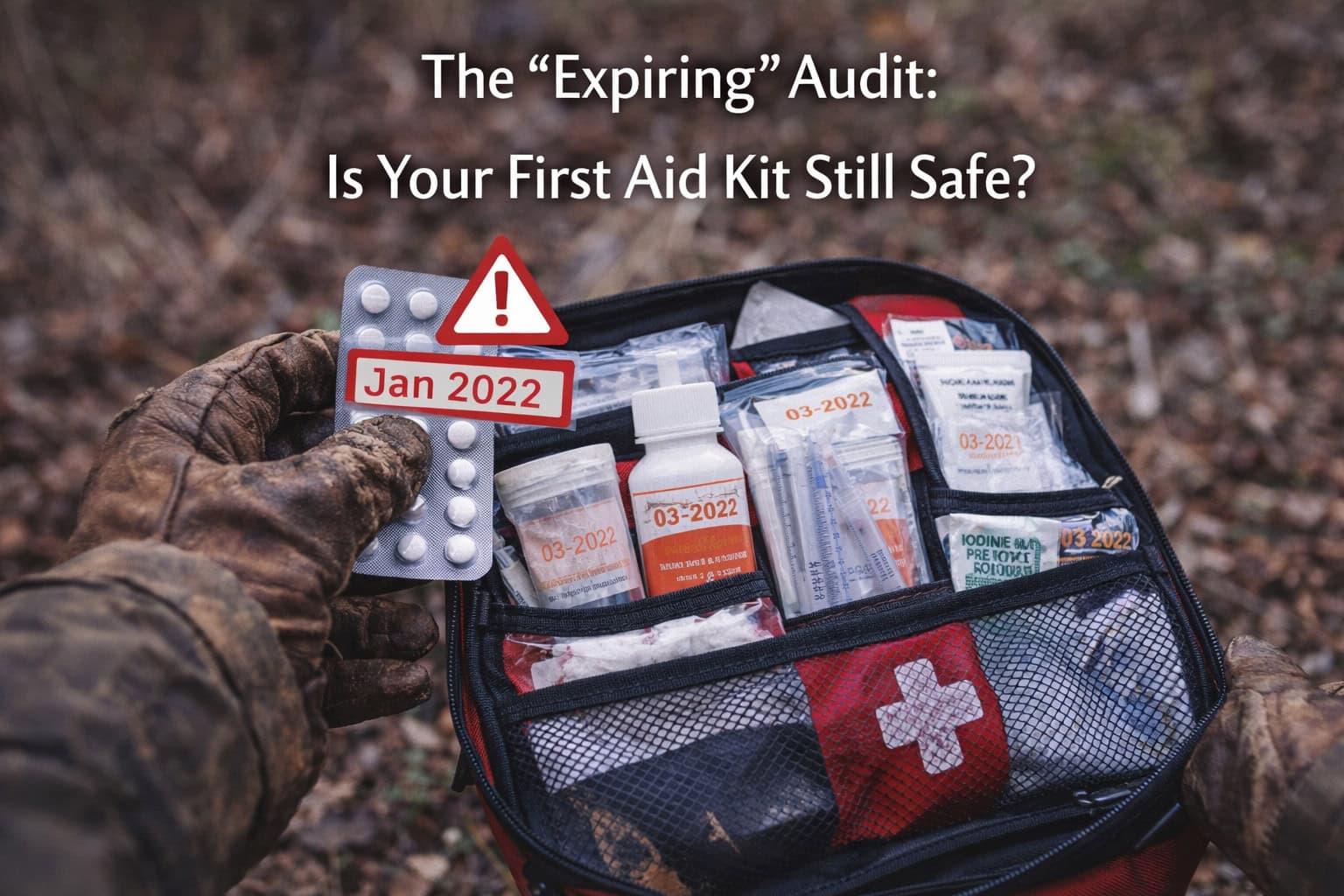
It’s sitting in your trunk, your garage, or the bottom of your "go-bag." You bought it three years ago, felt a sense of responsible satisfaction, and haven’t looked at it since. But here’s the reality of March 2026: A first aid kit is not a "set-and-forget" tool. It is a collection of biological and chemical products that are slowly breaking down.
If you’re heading out for a "Ghost Mode" weekend or a "Superbloom" scout, your kit is your only safety net. If that net is dry, brittle, or impotent, you aren't prepared—you’re just carrying extra weight.
Here is your 10-minute "Expiring Audit" to ensure your kit actually works when the adrenaline hits.
1. The "Big Three" Failure Points
Most people look for a single expiration date on the box. Don't fall for that. You need to check these three categories specifically, as they fail at different rates.
A. The Evaporators (Antiseptics)
Alcohol wipes and antiseptic swabs are the most common "silent failures." Even in sealed foil, the isopropyl alcohol eventually leaches through the packaging.
-
The Test: Give the packet a gentle squeeze. Does it feel like there’s a soft, moist cushion inside? If it feels flat or crunchy, the wipe is dry.
-
The Risk: A dry wipe is just a piece of scratchy paper. It won't disinfect a wound, increasing your risk of infection in the backcountry.
B. The Adhesives (Bandages & Tape)
Adhesive is a chemical compound that breaks down, especially when exposed to the extreme heat of a car trunk or the freezing cold of a garage.
-
The Test: Open one sacrificial bandage. Does it peel off the paper easily? Does it stick to your skin and stay there when you flex your joint?
-
The Risk: In the "Mud Season," a bandage that has lost its "tack" will fall off in minutes, leaving your "Dry-Foot" rule compromised and your wound exposed to silt.
C. The Potency Gap (Medications)
Ibuprofen, antihistamines, and aspirin don't usually become "toxic" the day they expire, but they do lose potency.
-
The 2026 Update: If you carry an EpiPen or the newer Neffy (epinephrine nasal spray), these dates are non-negotiable. Heat exposure can render these life-saving treatments useless in a single summer.
-
The Audit: Check the "Active Ingredients" shelf life. If your Ibuprofen is two years past its date, it might only provide $50\%$ of the pain relief you need for that twisted ankle.
The Audit Checklist: Keep, Toss, or Replace?
| Item | Signs of Failure | 2026 Pro-Tip |
| Nitrile Gloves | Brittle, yellowed, or tears easily. | Latex is obsolete. Ensure your kit is 100% Nitrile to avoid allergy risks. |
| Antibiotic Ointment | Separated (oil/goo) or discolored. | Switch to single-use packets to prevent cross-contamination. |
| Foil Blanket | Flaking or stuck to itself. | These are now mandatory in most 2026 safety standards. |
| Saline Wash | Cloudy liquid or expired date. | Once opened, a bottle loses sterility. Use single-use ampoules. |
| Tape | "Gooey" edges or won't unroll. | Replace every 2 years if stored in a vehicle. |
2. Why the Garage is a "Kill Zone"
If you store your gear in the garage, you are putting your first aid kit through a "torture test." The constant cycling between freezing nights and hot days causes:
-
Condensation: Moisture gets trapped inside sterile packaging, leading to mold.
-
Hydrolysis: Aspirin breaks down into acetic acid (if your kit smells like vinegar, toss the pills).
-
Seal Failure: Repeated expansion and contraction can pop the micro-seals on sterile gauze.
The Scout Rule: Keep your first aid kit in a "Climate-Controlled" zone. Store it in your linen closet or a dedicated "Ready Bin" inside your house, and only move it to your vehicle when you’re actually heading out.
3. The 2026 "New Essentials"
If you're updating your kit this week, add these two items that have become backcountry standards this year:
-
Naloxone (Narcan): Now a standard inclusion in many 2026 kits for emergency response.
-
Visual Tension Bandages: These "smart" bandages have rectangles printed on them that turn into squares when you've reached the correct pressure for a sprain or snake bite.
Scout Your Safety Before You Set Up
An audited first aid kit is your "Plan B," but "Plan A" is always picking a safe, accessible campsite. You don't want to be testing your bandages because you tripped over a hidden stump or pitched your tent on a rocky ledge.
Before you head out, use CampgroundViews to virtually walk your site. Their 360-degree tours allow you to see the "trip hazards" before you arrive. You can check for clear paths, level ground, and proximity to park exits, ensuring your first aid kit stays at the bottom of your bag where it belongs.
Click here to find your safest site with the Best Camping Tool Ever!
Would you like me to help you build a "Custom First Aid Manifest" based on the specific group size and terrain of your next trip?