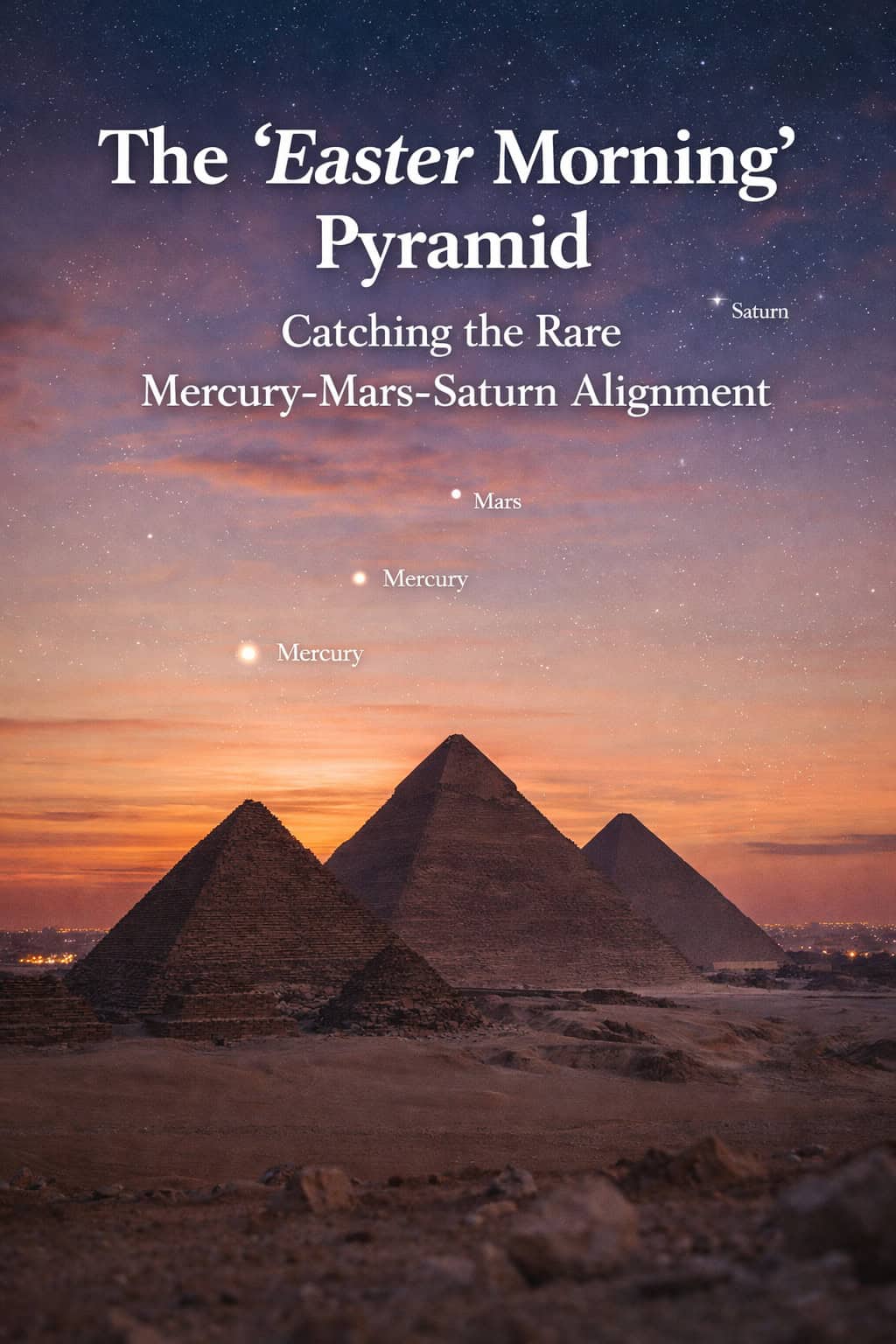
This Sunday, April 5, 2026, is Easter morning—a day traditionally centered on ascension and light. While many will be heading to sunrise services, the most profound "ascent" will be happening in the east-southeast sky.
In a rare celestial coincidence, three of our neighbor planets—Mercury, Mars, and Saturn—are currently grouping together to form what astronomers are calling a "planetary pyramid" or a "triple conjunction." Coming just days after the Artemis II launch and the peak of the Pink Moon, this alignment is the perfect excuse for an early-morning "Sky-Link" session.
Here is everything you need to know to catch the "Easter Morning" Pyramid before the sun washes out the show.
1. The Anatomy of the Pyramid
As we hit Easter Sunday, Mercury has just passed its "greatest western elongation" (its furthest point from the sun), making it as visible as it will be all year. Meanwhile, Mars and Saturn are rising earlier and earlier, "climbing" to meet it.
-
Mercury (The Peak): Sitting as the highest point of the "pyramid," Mercury will shine at a magnitude of roughly $m \approx -0.1$. It’s the brightest of the three, but also the most sensitive to the morning glow.
-
Mars (The Red Anchor): To the lower right of Mercury, you'll find the distinct, steady orange-red glow of Mars.
-
Saturn (The Golden Anchor): Completing the triangle to the lower left, Saturn will appear as a pale, golden-yellow "star."
The Visual: Imagine a tiny, slightly lopsided pyramid floating just above the horizon. While they will get even closer by April 19, the geometry on Easter morning is particularly striking, symbolizing a rare moment of cosmic balance.
2. Viewing Logistics: Timing is Everything
Because these planets are currently rising in the "pre-dawn" window, your timing needs to be precise.
-
The Window: Look toward the East-Southeast (ESE) approximately 45 to 60 minutes before local sunrise.
-
The Challenge: In the Northern Hemisphere, the ecliptic (the path the planets follow) sits at a shallow angle this week. The "pyramid" will be very low on the horizon—roughly 5° to 10° up.
-
The "Moon" Bonus: If you turn your back to the planets and look toward the Southwest, you'll see the 89% illuminated waning gibbous Moon nestled in the heart of the constellation Scorpius, right next to the red supergiant star Antares.
| Feature | Visual Characteristic | Magnitude |
| Mercury | Twinkling, silver-white | -0.1 |
| Mars | Steady, orange-red | 1.3 |
| Saturn | Steady, golden-yellow | 0.9 |
| Moon | Waning Gibbous (89%) | Near Scorpius |
3. The "Sky-Link" Hero’s Gear List
You don't need a telescope for this alignment, but a little help goes a long way.
-
Binoculars (Essential): Because the planets are in the "twilight zone," binoculars will help you pull Mercury out of the brightening sky.
-
The "Horizon Scout": To see the pyramid, you need a site with a dead-flat horizon. Even a small hill or a cluster of trees will block the view.
-
2026 Smartphone Tech: Use your phone’s "Night Mode" with a 2-second exposure. If you can keep the phone steady, the sensor will easily capture the color contrast between the Red Planet and the Golden Planet.
4. The Spiritual Bio-Hack: A "Sacred" Start
There is a profound physiological benefit to witnessing a planetary alignment at dawn. It triggers the "Awe Effect," a psychological state that reduces inflammation, lowers stress levels, and increases your sense of connection to the world around you.
On this specific Easter morning, with Artemis II currently in orbit and the Pink Moon fading, the "Easter Morning" Pyramid serves as a reminder that we are part of a much larger, beautifully synchronized system.
Scout Your Sunrise Before the Sun Rises
The "Easter Morning" Pyramid only works if you have a clear, unobstructed view of the ESE horizon. If you're tucked in a forest or a deep valley, the planets will be "hidden" by the terrain long before you can see them.
Before you head out for your Holy Week escape, use CampgroundViews to virtually scout your site. Their 360-degree virtual tours let you "stand" in your campsite and look at the exact horizon line. You can ensure you have a clear view of the East-Southeast, check for tree-line obstructions, and pick the perfect "launchpad" for your Easter morning stargazing.
Click here to find your perfect sunrise site with the Best Camping Tool Ever!