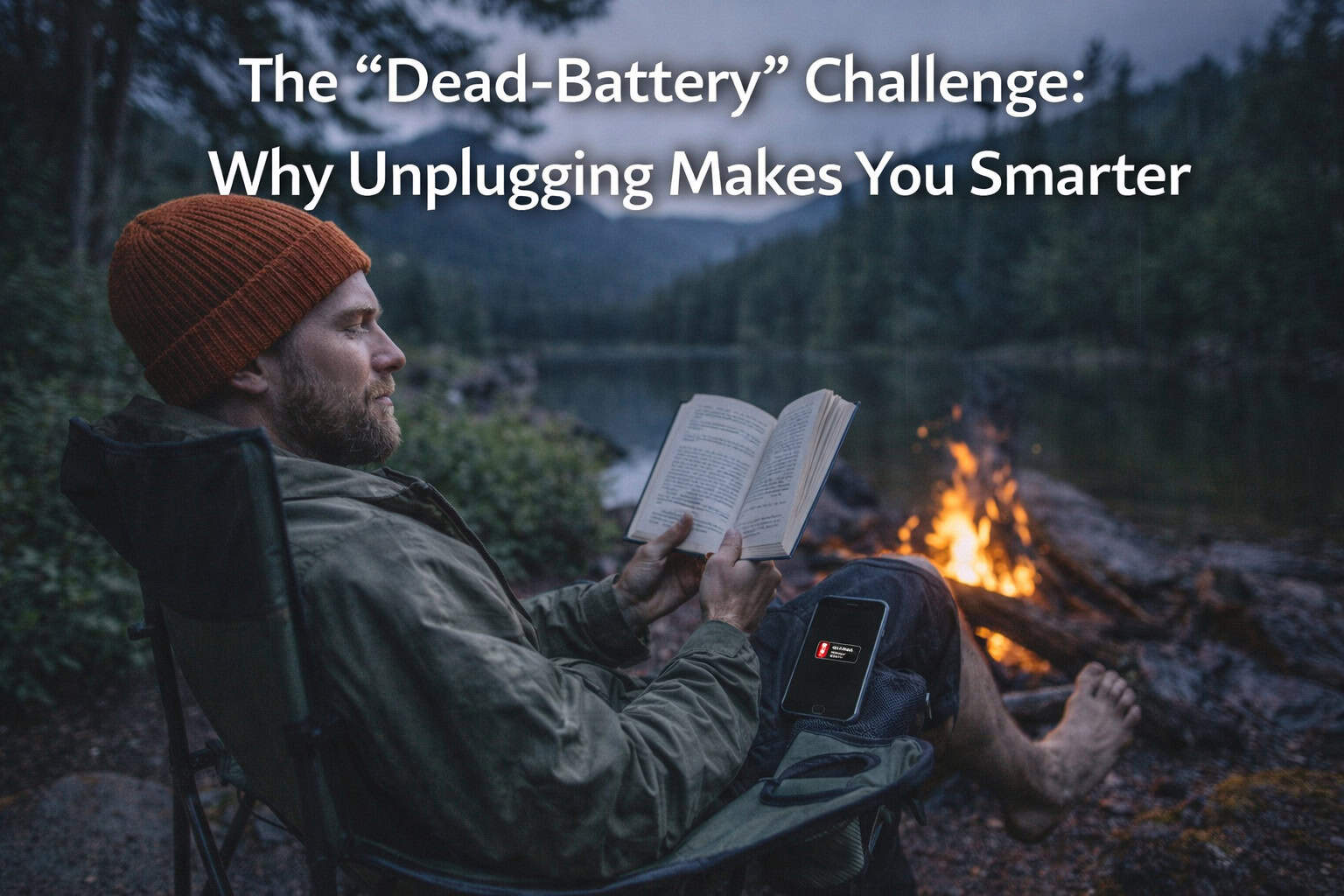
Have you ever looked at your smartphone’s battery icon, seen it dipped into the single digits, and felt a genuine, creeping sense of dread? We've all been there. But have you ever stopped to consider that your own mental battery might be in that same critical, red zone—and you’re not even looking for a charger?
Welcome to the modern condition: hyper-connected, always-on, and utterly drained. We treat our devices better than we treat our brains. We ensure they have a full charge before we leave the house, we find them the optimal spot for a signal, and we update their software religiously. Our own "operating system," meanwhile, is lagging, prone to crashing, and desperately needs a system restore.
That's where the "Dead-Battery" Challenge comes in. It’s not about waiting for your device to die; it's about voluntarily letting your digital life go "dead" for a specified period to find out what happens when your brain finally gets a chance to recharge. And here's the surprising twist: this act of "unplugging" doesn’t just make you calmer; it actually makes you smarter.
What is The "Dead-Battery" Challenge?
It's a simple, customizable, and voluntary digital detox. You decide the parameters, but the core rule is a complete secession from screens and digital connectivity for a set amount of time.
-
Level 1: The Evening Fade. From 7:00 PM until you go to bed, all screens are off. No phone, no TV, no laptop.
-
Level 2: The 24-Hour Reset. A full Saturday or Sunday with zero digital devices. Notify your essential contacts beforehand, then power down.
-
Level 3: The Weekend Withdrawal. A Friday evening to Monday morning unplug. This is the "deep charge."
The goal is to feel the initial "twitch"—the phantom buzz, the urge to check, the boredom—and sit with it until it passes, revealing the mental clarity on the other side.
Why Unplugging is a Cognitive Performance Enhancer
We tend to think of smarter as "knowing more facts" or "processing information faster." But true intelligence also includes creativity, focus, problem-solving, emotional regulation, and wisdom. Constant connectivity attacks every single one of these. Here’s how unplugging fights back.
1. It Restores Your "Attention Capital"
Your attention is a finite resource, like a bank account. Every notification, every swipe, every headline "swipe" is a withdrawal. On a typical plugged-in day, you are making thousands of micro-withdrawals. This leads to what psychologists call "attention residue." When you switch from one task (work) to another (checking a text), part of your focus stays stuck on the previous activity. Your brain is never 100% present, making you feel scattered, inefficient, and slow.
Unplugging is a deposit. It allows your brain to stop task-switching and start "unitasking," rebuilding your ability to focus deeply on one thing at a time—the hallmark of high-level cognitive work.
2. It Activates Your "Default Mode Network"
When you are actively focused on a task, your brain uses certain networks. But when you are "doing nothing"—daydreaming, walking without a purpose, staring out a window—a different system, the Default Mode Network (DMN), lights up.
The DMN is crucial for creativity, introspection, and consolidating memories. It connects distant ideas, processes your emotions, and solves problems you didn't even know you were working on. If you fill every moment of "boredom" with scrolling, you never allow the DMN to activate. You are essentially starving your own creativity.
Unplugging is the "nothing" your DMN craves. It's in those quiet, "boring" moments that your next great idea is born.
3. It Upgrades Your Sleep (Your Brain’s Maintenance Cycle)
Sleep is not just rest; it's a critical maintenance period. Your brain uses this time to:
-
Flush out toxins that build up during the day.
-
Consolidate memories, moving them from short-term to long-term storage.
-
"Rehearse" and strengthen newly learned skills.
The blue light from screens suppresses melatonin (the sleep hormone), and the stimulating content keeps your mind racing, preventing the deep, restorative sleep necessary for these functions.
Unplugging gives you a better "maintenance cycle." A single night of screen-free time before bed can improve sleep quality, which directly translates to sharper focus, better memory, and improved problem-solving the next day. One study even suggested that the attention improvement from a two-week digital detox was comparable to reversing 10 years of age-related cognitive decline.
4. It Improves Information Processing and Learning
The internet provides an endless stream of information, but it also creates information overload. When you are bombarded, your brain struggles to filter out distractions and decide what's important, hindering your ability to retain and learn new things. A break from the constant input allows your brain to "digest" and organize the information it has already received.
Unplugging creates space for wisdom. Intelligence isn't just about consuming data; it's about synthesis, reflection, and understanding, all of which require time and quiet.
Are You Ready to Take the Challenge?
Your mental battery is blinking red. You can feel the lag in your thoughts, the fuzziness in your focus, and the drought in your creativity. You don't need a new app, a faster processor, or more data. You need a recharge.
This weekend, I challenge you to a "Level 2: 24-Hour Reset." Power down your devices, notify your circle, and step into the analog world. Don't worry about what you'll miss; worry about what you’re missing right now by not being fully present in your own life.
Tips for a Successful "Dead-Battery" Challenge:
-
Set a Clear Intention: Know why you are doing it (e.g., to finish a book, to have an uninterrupted conversation, to feel calmer).
-
Plan Analog Alternatives: Have books, board games, art supplies, or a hiking route ready. Don't leave a vacuum of time.
-
Notify Your Circle: Tell essential family and friends you'll be offline and how to reach you in a true emergency (e.g., a landline, a pre-arranged check-in).
-
Create Tech-Free Zones: Start with your bedroom and dining table.
-
Start Small: If 24 hours seems impossible, start with the "Evening Fade."
Don't treat your brain like an old, reliable battery you can just run into the ground. Give it the charge it deserves, and watch how much smarter, more creative, and more present you become.
Ready to find your perfect place to unplug?
The biggest obstacle to a successful "unplugged" weekend is ending up in a crowded, noisy parking lot when you were dreaming of a quiet forest. Don't leave your peace of mind to chance.
Before you head out on your "Dead-Battery" Challenge, use CampgroundViews to see your exact campsite before you book. Their 360-degree virtual tours let you scout for the quietest, most secluded spots, ensuring your "recharge" is exactly what you need.
Click here to find your next escape with the Best Camping Tool Ever!