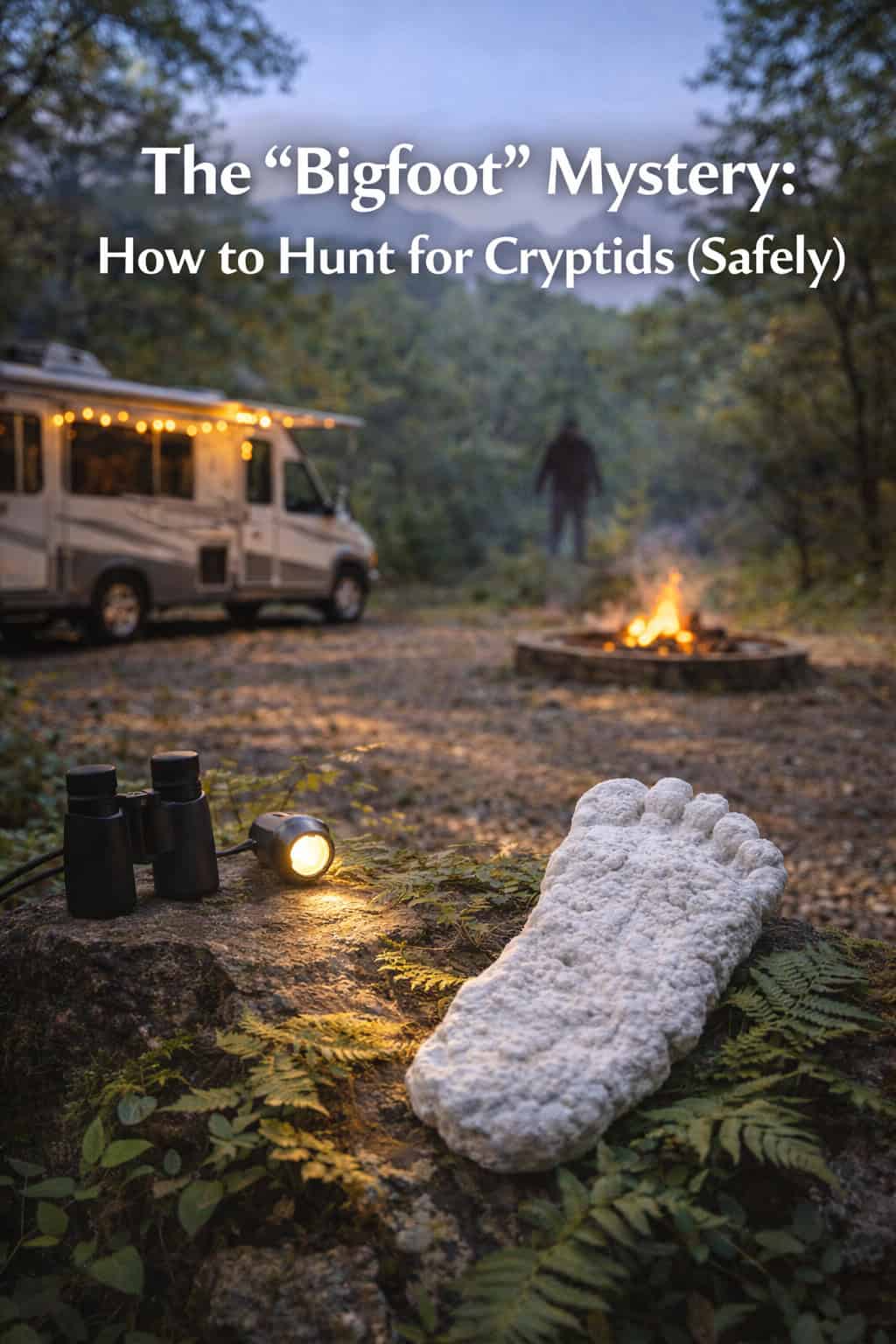
Becoming a Cryptozoologist in Your Own Campsite
You’re sitting by the fire, the shadows are stretching long across the trees, and suddenly you hear a heavy thud deep in the brush. Is it a bear? A deer? Or is it the legendary Sasquatch?
"Cryptids" are creatures that people think exist but haven't been scientifically proven yet—like Bigfoot, the Yeti, or the Loch Ness Monster. Hunting for them isn't just about finding a giant ape-man; it’s about becoming a Master Observer of the natural world. Here is how to start your "Bigfoot Investigation" without ever putting yourself in danger.
1. The Science of "Track Casting"
The Concept: If a 800-pound creature walks through the mud, it’s going to leave a "fossil" in the dirt.
-
The Hunt: Look for "disturbed earth" near creek beds or soft trail edges.
-
The Physics: A real animal track has a "Pressure Plate." Look for where the weight was pushed down hardest (usually the heel or the ball of the foot).
-
The Mission: If you find a giant print, don't step on it! Place a stick next to it for "Scale" and take a photo from directly above.
-
Pro Tip: Real Bigfoot hunters use Plaster of Paris to make a 3D mold of the footprint to study later in their "RV Lab."
2. The "Tree Knock" Communication
The Theory: Many people believe Sasquatches communicate over long distances by hitting trees with heavy branches.
-
The Action: Find a fallen, dry branch. Give a single, loud "WHACK" against a solid tree trunk.
-
The Wait: Silence is your best tool. Listen for at least 60 seconds.
-
The Science: Sound travels through wood and air differently. A "wood knock" carries much further than a human shout.
-
The Reality Check: If you hear a knock back, it might be another camper playing the same game—or a Pileated Woodpecker looking for lunch!
3. Looking for "Structure" (The Stick Nest)
The Theory: Some researchers think Bigfoots build "structures" out of fallen logs and branches to mark their territory.
-
The Hunt: Look for large branches leaned against trees in a "V" or "X" shape that look too heavy for the wind to have moved.
-
The Observation: Check the ends of the branches. Are they snapped (natural) or do they look "twisted" (which would require a lot of strength)?
-
The Logic: Sometimes "structures" are just "Deadfall"—trees that fell over during a storm. A true scientist looks for patterns that don't look accidental.
4. The "Thermal Signature" Secret
The Science: Every living thing gives off Infrared Heat.
-
The Tech: If you have a thermal camera or even just a good pair of binoculars, scan the "Tree Line" just after sunset.
-
The Goal: You are looking for a "heat bloom" that is shaped like a tall human.
-
The Safety Rule: If you see something large moving, stay back. Whether it's Bigfoot or a Grizzly Bear, you always want to be a "Long-Distance Observer."
5. The "Code of the Cryptid Hunter"
A true Cryptozoologist follows three rules to stay safe and keep the mystery alive:
-
Never Hunt Alone: Always have a "Research Partner" (like a sibling or parent) with you.
-
Carry a Whistle: If you get turned around in the woods while following "clues," three loud blasts on a whistle is the international signal for "I need help!"
-
Respect the Real Neighbors: Remember that the woods belong to the bears, cougars, and elk. Don't go off-trail or into thick brush where real (and dangerous) animals might be sleeping.
Pro Tip: The "Scent" Variable. Some people say Bigfoot smells like a "skunk mixed with a wet dog." If the air suddenly smells very "musky" and weird, it’s a sign that something big is nearby. It’s usually a black bear, so give it plenty of space!
Final Thoughts
Whether Bigfoot is real or just a great campfire story, "hunting" for him makes you a better explorer. You learn to listen to the wind, spot tiny details in the mud, and appreciate the "wildness" of the forest. The mystery is what makes the adventure fun!
Keep your eyes peeled, Hunter!
🐟 Want to find a site tucked deep into "Bigfoot Territory"? Some parks are famous for sightings! CampgroundViews.com lets you take a 360-degree tour of the park. You can look at how dense the forest is around each site and pick a spot right on the "Edge of the Wild" for your investigation.
Find your "Base Camp" at CampgroundViews.com!