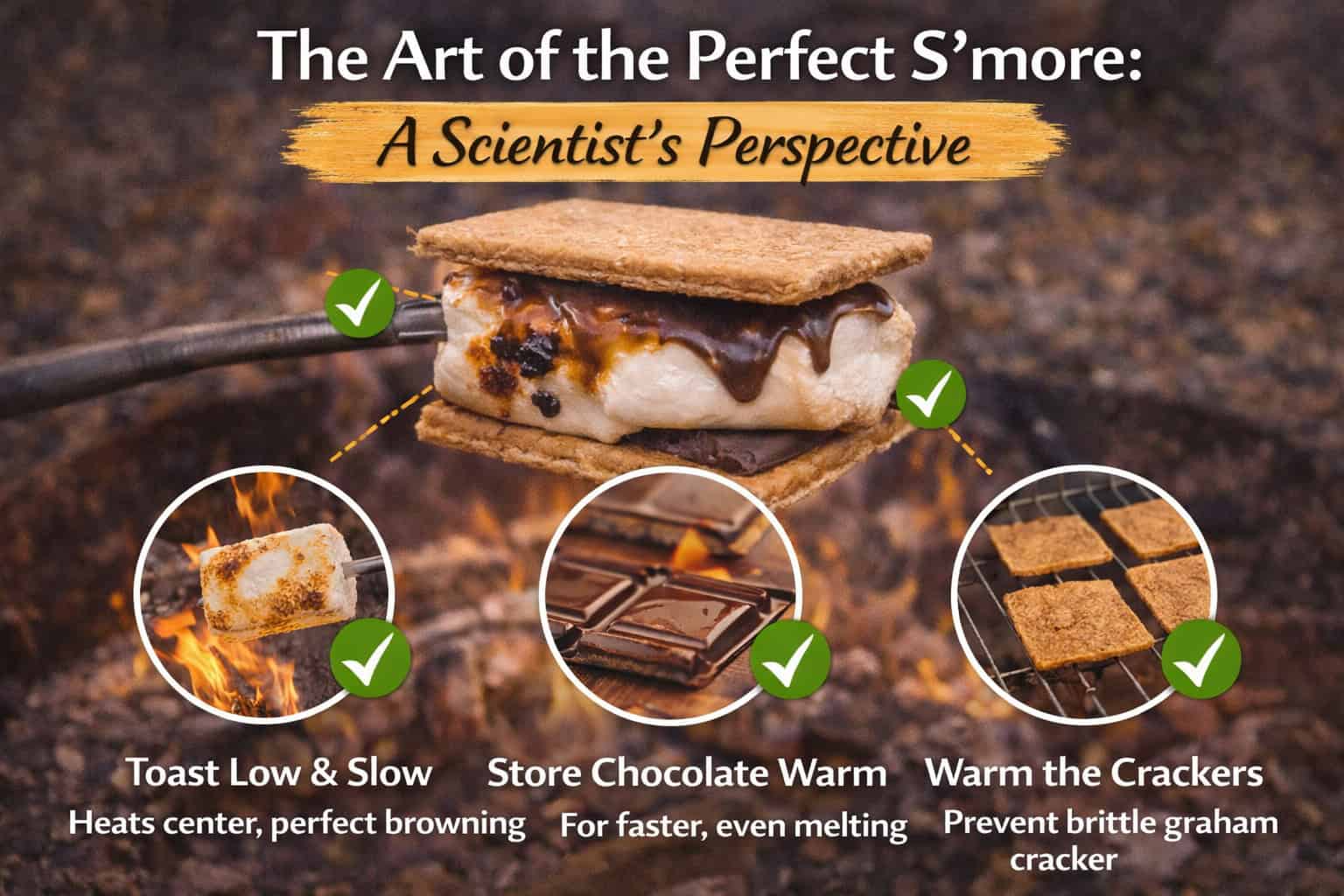
The Art of the Perfect S’more: A Scientist’s Perspective
How to Use Chemistry and Physics for the Ultimate Treat
To most people, a s'more is just a sticky snack. But to a S’more Scientist, it is a complex engineering project. To get that perfect mix of crunchy, gooey, and melty, you have to understand how heat moves and how molecules change.
If you’re tired of burnt marshmallows and cold chocolate, put on your lab coat (or your hoodie) and follow these scientific laws for the ultimate results.
1. The Law of Thermal Transfer (The Chocolate)
The Problem: Most people put cold chocolate on a hot marshmallow. The marshmallow cools down, but the chocolate stays hard. The Scientific Fix: You must pre-heat the base.
-
The Action: Place your graham cracker and chocolate square on a flat rock near the edge of the fire (not in the fire!) or on the dashboard of the RV in the sun while you roast.
-
The Result: By the time the marshmallow is ready, the chocolate is already "softened," meaning it only needs a tiny bit of heat to reach a delicious liquid state.
2. The Maillard Reaction (The Marshmallow)
The Problem: Catching your marshmallow on fire (the "Flaming Torch" method) creates carbon, which tastes bitter and burnt. The Scientific Fix: You want the Maillard Reaction. This is a chemical reaction between amino acids and reducing sugars that gives browned food its distinctive flavor.
-
The Action: Hold your marshmallow about 6 inches above a bed of glowing red coals, not the open flames. Rotate it slowly like a planet orbiting the sun.
-
The Result: The outside turns a perfect golden brown (caramelization), while the inside turns into a liquid "goo" without burning.
3. The Structural Integrity Test (The Graham Cracker)
The Problem: You take a bite and the whole s’more shatters, dropping your hard-earned marshmallow into the dirt. The Scientific Fix: Use pressure distribution.
-
The Action: When you "clamp" the marshmallow between the crackers, don't just squeeze the middle. Use your fingers to apply gentle, even pressure across the entire surface of the cracker.
-
The Result: The marshmallow spreads out to the edges, acting like "industrial glue" that holds the crackers together instead of breaking them.
4. The "Insulation" Phase (The Wait)
The Problem: Eating the s’more the exact second it comes off the stick. The Scientific Fix: Allow for residual heat soak.
-
The Action: Once the s’more is assembled, wait exactly 30 seconds before eating.
-
The Result: This gives the "latent heat" from the marshmallow time to finish melting the chocolate and softening the cracker. This 30-second window is the difference between a good s'more and a legendary one.
5. The "Flavor Variable" (Experimental Add-ins)
A true scientist is always running experiments. Once you master the "Control Group" (Chocolate + Marshmallow + Graham), try changing one variable:
-
Variable A: Use a peanut butter cup instead of a chocolate bar (adds healthy-ish fats!).
-
Variable B: Use a cinnamon cracker instead of honey (adds spice aromatics).
-
Variable C: Add a thin slice of strawberry (adds acidity to balance the sugar).
Scientist’s Note: The "Stick" Factor. Use a clean, dry stick or a metal skewer. If the stick is wet or green, it will steam the inside of the marshmallow instead of roasting it, making it "mushy" instead of "gooey."
Final Thoughts
When you treat s'mores like a science, you never have a "bad batch." You get a perfect, golden-brown, chocolatey masterpiece every single time. It takes a little more patience, but the data shows that the taste-testers (that’s you!) will be much happier with the results.
Class dismissed—time to eat!
Want to find the perfect fire pit for your next experiment? Some fire pits are too deep or too shallow for a good roast. CampgroundViews.com lets you take a 360-degree tour of the campsite. You can zoom in on the fire ring to see exactly where you'll be setting up your "lab" before you arrive.
Find your lab at CampgroundViews.com!