How Tiny Engineers Use Physics to Air-Condition the Underground
It’s 95°F outside. The pavement is hot enough to fry an egg, and your RV’s air conditioner is humming at full blast just to keep you from melting. But right beneath your feet, in a giant mound of sand, thousands of ants are perfectly cool and comfortable.
Ants don't have electricity, fans, or coolant. Instead, they are masters of Passive Ventilation and Thermodynamics. As an Ant-Hill Architect, your job is to decode the "High-Tech" cooling systems hidden in a pile of dirt.
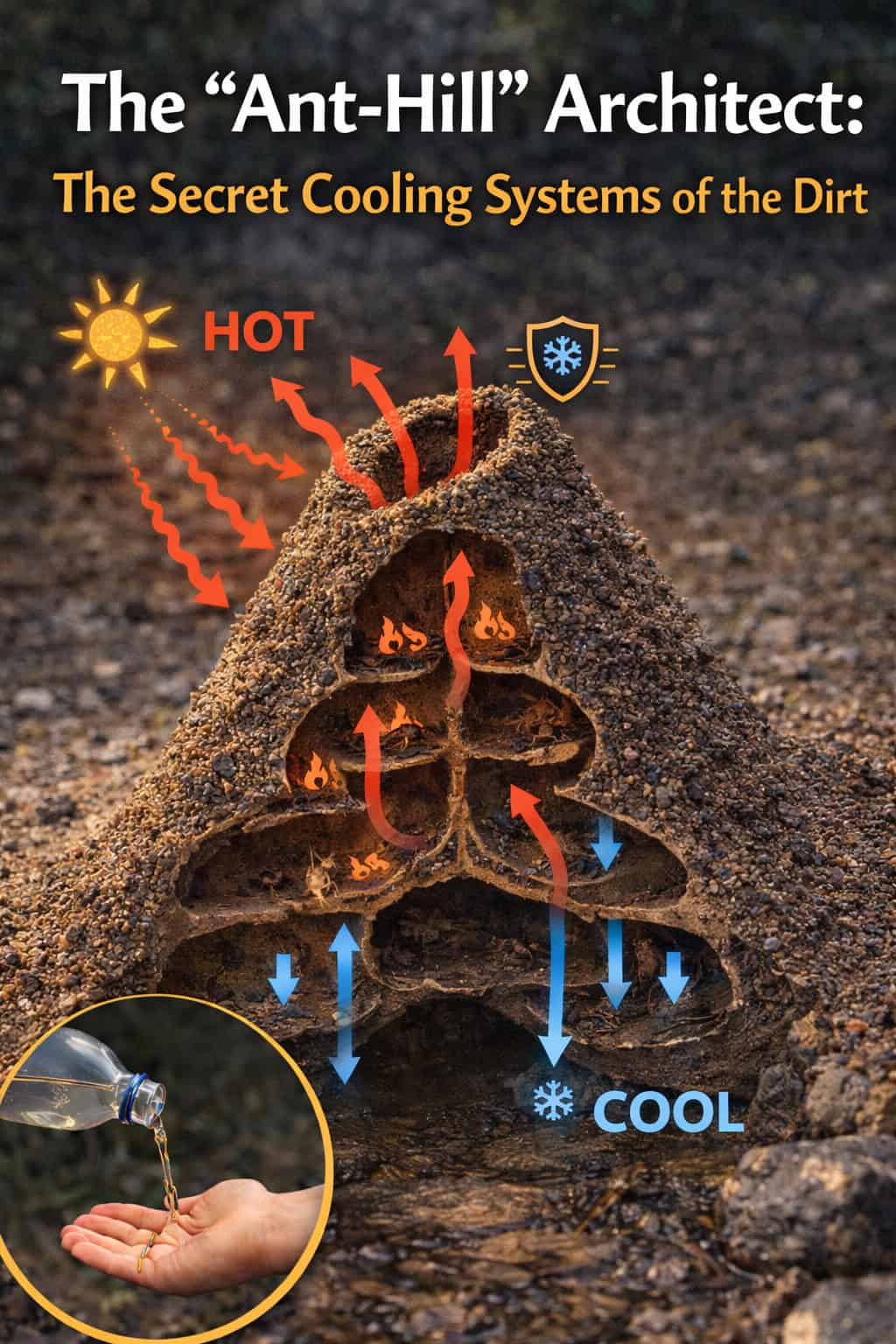
1. The "Chimney" Effect (Passive Ventilation)
The Science: Have you noticed that some ant hills have a large hole at the very top and smaller holes around the sides?
-
The Physics: This is based on Bernoulli’s Principle. Wind blows faster over the top of the mound than it does near the ground.
-
The Action: Fast-moving air creates Lower Pressure. This "sucks" the stale, hot air out of the top hole, which "pulls" fresh, cool air in through the side vents.
-
The Result: Even on a still day, a tiny breeze is enough to keep a constant "draft" flowing through the tunnels, just like a high-end architectural home!
2. The "Thermal Mass" of the Earth
The Science: Dirt is an incredible Insulator.
-
The Physics: The deeper you go into the ground, the more the temperature stays the same, no matter what the sun is doing. This is called Thermal Inertia.
-
The Action: Ants build their "Nursery Rooms" deep underground where the temperature stays a steady 60-70°F.
-
The Engineering: By moving the babies (larvae) up and down the tunnels during the day, the ants are "balancing" the temperature, acting like a living thermostat for the colony.
3. The "Solar Collector" (The Mound)
The Science: In the morning, ants actually want heat to wake up the colony.
-
The Physics: The "Hill" itself is a solar collector. Ants often build their mounds with a steeper slope facing the South (to catch the most direct sunlight).
-
The Observation: Look at an ant hill in the morning. You’ll see the ants huddled on the sunny side. They are soaking up Thermal Energy into their bodies and then walking deep into the tunnels to "release" that heat, acting like tiny, fuzzy space heaters!
4. Humidity Control (The Swamp Cooler)
The Science: To keep their tunnels from collapsing and their eggs from drying out, ants need Humidity.
-
The Physics: Ants bring moisture into the mound by carrying damp bits of dirt from deep underground.
-
The Result: As that moisture evaporates into the air of the tunnels, it triggers Evaporative Cooling (just like your "Rainforest RV" or a sweating tree). This drops the temperature inside the mound by another few degrees.
5. The "Trench" Experiment
The Science: You can see this cooling system in action without disturbing the ants!
-
The Action: Find a large ant mound. Without touching it, hold your hand about an inch above the main hole at the top.
-
The Observation: You might feel a tiny "waft" of air. That is the Convection Current—the hot air from the colony escaping into the sky so the babies stay cool below.
The "Builder's Code": Never kick or destroy an ant hill! It takes the colony months of hard labor to engineer those "vents" and "tunnels." If you break the top, you "break" their air conditioner, and the ants inside could overheat before they can fix it. Be a Respectful Architect and observe from the side!
Final Thoughts
The next time you see a "simple" pile of dirt, remember that you’re looking at a masterpiece of climate engineering. Ants have solved the "Summer Heat" problem using nothing but the shape of the ground and the laws of physics. We might even learn a thing or two from them for our own homes!
Stay cool, Architect!
🐟 Want to find a site with some "Neighborhood Engineers" to study? Look for sites with sandy soil or open clearings! CampgroundViews.com lets you take a 360-degree tour of the park. You can look at the ground around each site to find the perfect "Construction Zone" where the best Ant-Hill Architects have set up shop.
Scout the "High-Tech" dirt at CampgroundViews.com!