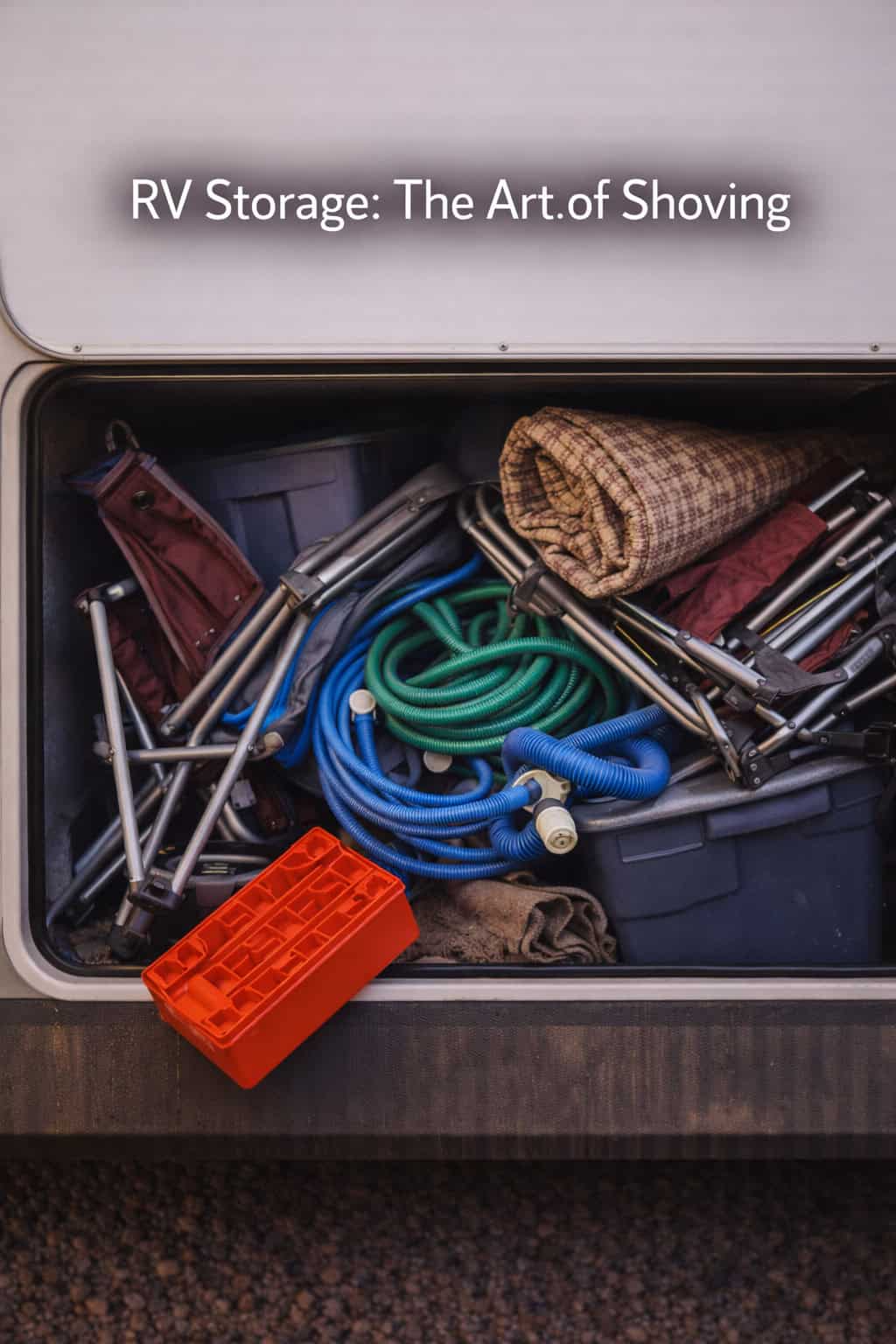
(Because space is a suggestion.)
If you’ve ever owned an RV, you know this truth:
Storage is not about organization.
It’s about negotiation.
RV storage operates on three principles:
-
If it fits, it ships.
-
If it almost fits, push harder.
-
If it doesn’t fit, you’re just not trying creatively enough.
Welcome to the art of shoving.
The First Trip: Optimism
When you first pack your RV, everything has a place.
You use bins.
You stack neatly.
You tell yourself, “We won’t bring too much.”
That lasts exactly one trip.
Because then you realize you also need:
-
Extra leveling blocks
-
A longer hose
-
A backup hose
-
Two folding tables
-
The “good” camp chairs
-
The backup chairs
Suddenly, space feels theoretical.
The Cabinet That Fights Back
Every RV has that one cabinet.
The one that looks spacious until you try to use it.
You open it.
You place something inside.
You close it gently.
You walk away.
It pops open.
You stare at it.
This cabinet has chosen conflict.
The Storage Bay Avalanche
Exterior storage compartments are magical.
They appear generous.
Until you open one mid-trip and everything launches toward freedom.
Now you’re:
-
Catching a folding chair
-
Blocking a rogue sewer hose
-
Pretending this is under control
Every camper has done the “open slowly and pray” maneuver.
It rarely works.
The Mystery Items
There are always things in your RV that you don’t remember packing.
Items like:
-
An extension cord that doesn’t fit anything
-
A random tool
-
A piece of hardware from something you fixed once
-
A flashlight with no batteries
You keep them.
Because “just in case” is powerful logic.
The Emotional Tetris
Packing up is a full strategy session.
You stand there holding a bin thinking:
“If I rotate this 14 degrees and remove the mat…”
You adjust.
You compress.
You breathe heavily.
You finally close the hatch.
It latches.
You feel victorious.
Until you remember the grill.
Why We Always Bring Too Much
Camping makes you want to be prepared for everything.
Rain.
Wind.
Heat.
Cold.
Wildlife.
Social situations.
The result?
You pack for all seasons and all scenarios.
And somehow still forget something important.
How to Actually Improve RV Storage
You don’t need more space.
You need smarter systems.
Try this:
-
Use collapsible bins. They shrink when empty.
-
Store frequently used items near the door.
-
Label important containers.
-
Keep “trip-only” gear separate from “emergency” gear.
-
Once a season, remove everything and reassess.
If you haven’t used it in a year, it may not deserve real estate.
Storage is less about capacity.
It’s about access.
The Moment It All Makes Sense
Despite the chaos…
Despite the shoving…
Despite the avalanche risk…
There’s something satisfying about a packed RV.
Everything you need is inside.
Tools.
Food.
Chairs.
Comfort.
It may be crammed.
But it’s yours.
And it’s ready.
Final Thoughts
RV storage isn’t neat.
It isn’t minimal.
It isn’t Instagram-worthy.
It’s practical.
It’s creative.
It’s slightly aggressive.
And it works.
Because the goal isn’t perfect organization.
The goal is being prepared when you need something — even if it takes 10 minutes to find it.
🐟 Want to pack smarter for your next trip? Use Campground Views to preview your campsite ahead of time so you only bring what the terrain and layout actually require.