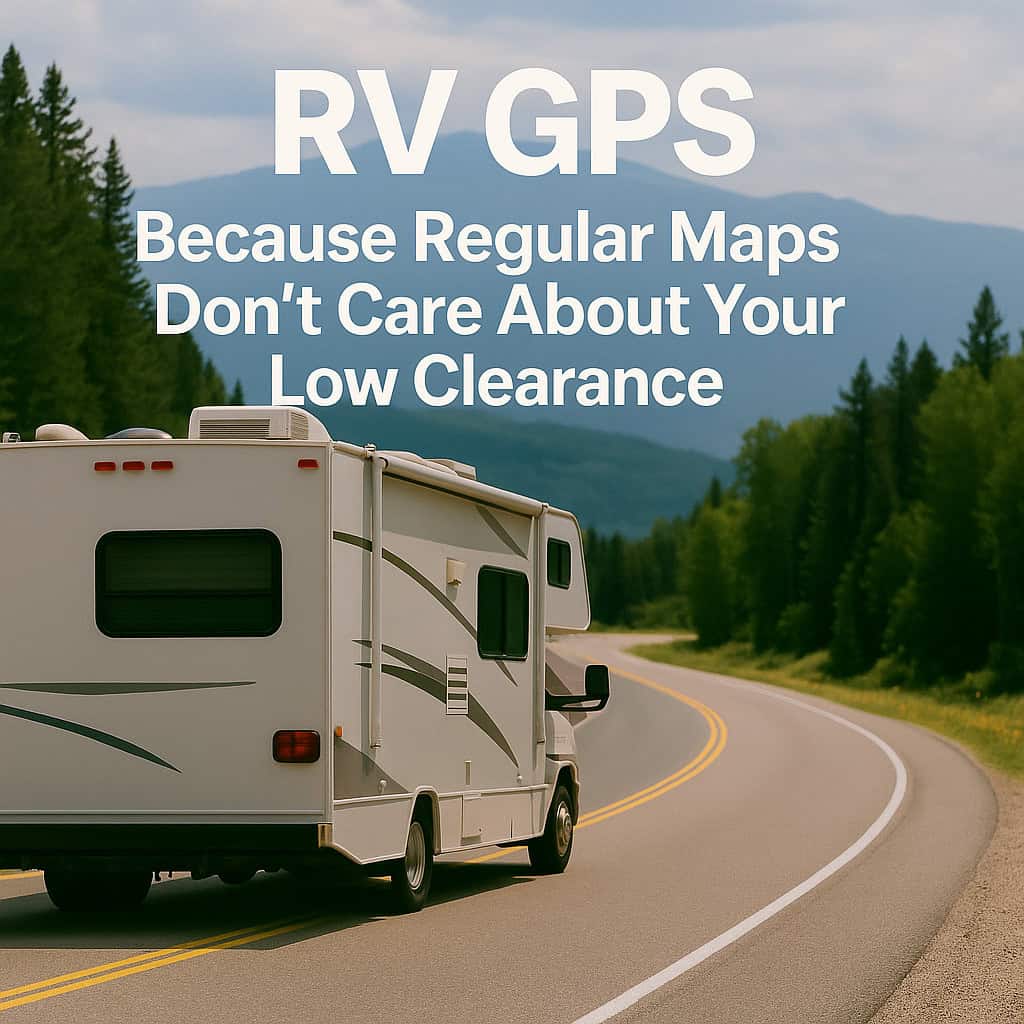
("Turn left in 200 feet… into that 11'6” bridge. Good luck!")
Let’s be honest:
Standard GPS is great for cars.
But you? You’re rolling a 12-foot-tall, 30-foot-long, propane-carrying hotel suite on wheels.
And guess what your average mapping app doesn’t care about?
-
Your rig height
-
Your weight limits
-
Whether that cute shortcut includes a one-lane gravel cliff road
-
And if there’s a bridge up ahead that wants to shear off your air conditioner like a soda tab
If you’ve ever white-knuckled it under a questionable bridge or screamed at your phone while doing a 37-point turnaround, it’s time for the RV GPS upgrade.
Here’s why it matters—and what to look for.
🧠 1. Regular GPS: Great for Sedans, Terrible for Slide-Outs
Your average map app was built for commuters.
It’ll cheerfully route you through:
-
Urban streets with tight turns
-
Residential zones with low-hanging limbs
-
Tunnel systems where propane is banned
-
And scenic “shortcuts” better suited to mountain goats
🎯 Spoiler: Siri does not care if you’re towing a fifth wheel.
🧭 2. What RV GPS Actually Does Better
A true RV GPS asks the important questions first:
-
What’s your vehicle height, weight, length, and axle count?
-
Are you towing?
-
Got hazmat restrictions (aka propane tanks)?
-
Prefer interstates, rest areas, or low-grade climbs?
Then it builds your route like it actually wants you to survive it.
🧠 Some even include:
-
Campground directories
-
Low clearance alerts
-
Grade warnings
-
Fuel station filters for RV-friendly stops
🚫 3. Low Clearance = High Stress
Let’s talk numbers:
-
Standard interstate clearance: 14 feet
-
Average RV height: 11–13.5 feet
-
Surprise bridge underpass: 11’6” with zero warning
-
Result: You either hit the brakes—or hit the bridge
🎯 Don’t gamble. That air conditioner is expensive, and bridges always win.
📱 4. App or Device? Choose Your Adventure
🖥 Standalone GPS Units (Garmin, Rand McNally, etc.)
✅ Pros:
-
Purpose-built for RVs
-
Preloaded maps—no signal needed
-
Big screens, easy mount, clear audio
-
No distractions (like texts or Instagram pings)
❌ Cons:
-
Pricier upfront
-
Occasional software updates via clunky cables
📲 RV GPS Apps (CoPilot, RV Life, etc.)
✅ Pros:
-
Affordable or freemium models
-
Use your own phone/tablet
-
Often tie into campground reviews, weather, etc.
-
Sync with trip-planning platforms
❌ Cons:
-
Need data or downloads
-
Battery hogs
-
Can get cranky if notifications are flying
🧠 Pro tip: Even with an app, get a good phone mount. One pothole = chaos.
💬 Final Thoughts
Your RV isn’t a Corolla.
So don’t trust it to maps that think it is.
Whether you go full Garmin or app-based with bells and whistles, one thing’s clear:
A dedicated RV GPS is more than a luxury—it’s your peace of mind in digital form.
Because nothing ruins a scenic route like reversing uphill while traffic honks behind you.
🐟 Want to preview tricky roads before you trust even your GPS?
Use Campground Views to virtually explore campground entrances, road grades, and tight turns—so your arrival is smooth, not suspenseful.
🔗 Follow us for more road-tested RV tips, sanity-saving tools, and gear that keeps your adventures rolling smart.