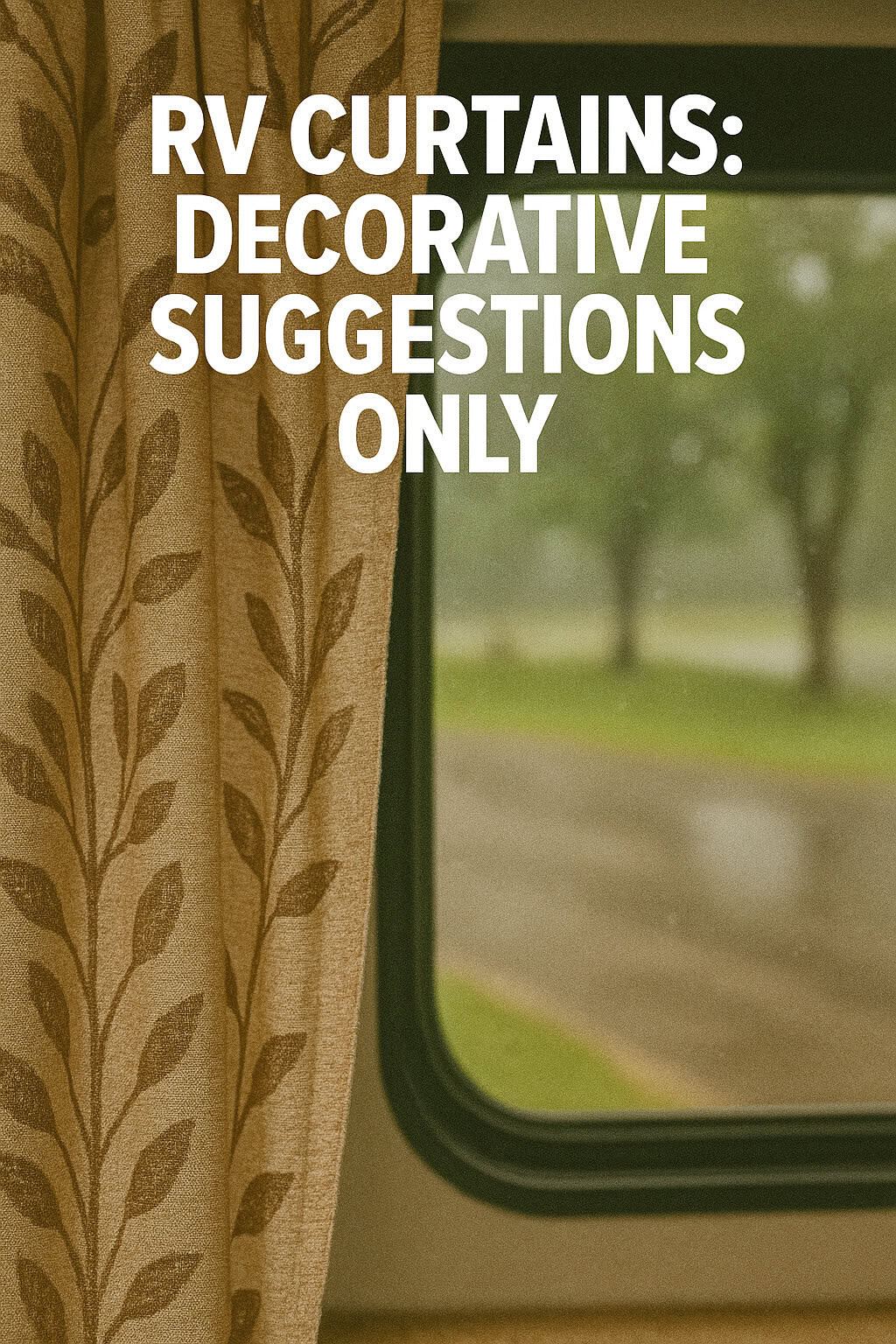
(Because privacy is apparently a vibe, not a guarantee.)
House curtains have jobs.
They close. They block light. They provide privacy. They behave.
RV curtains, on the other hand, are more like polite recommendations.
They suggest darkness.
They hint at privacy.
They wave gently while sunlight and silhouettes do whatever they want.
If you’ve ever thought, “Surely they can’t see us…” — they can.
Here’s why RV curtains are mostly symbolic, and how we all learn to live with it.
🌅 1. They Block Exactly 37% of the Light
No matter how thick they look, RV curtains allow:
-
glowing edges
-
dramatic silhouettes
-
the sun to laser-focus directly on your face at 6:14 a.m.
You close them carefully. You overlap them.
The sun laughs and finds a gap the width of a pencil.
Blackout? Technically.
Effective? Emotionally debatable.
👀 2. At Night, You’re in a Fishbowl
Daytime? You feel hidden.
Night-time? You’ve created a well-lit stage production called “People Doing Normal Things.”
With the lights on inside:
-
silhouettes are crisp
-
movement is amplified
-
neighbors can absolutely tell you’re still awake
You stop worrying about privacy and start mastering strategic lighting angles.
🪟 3. The Windows Are an Unusual Size on Purpose
RV windows are:
-
too narrow for normal curtains
-
too short for standard solutions
-
placed at heights that defy logic
Which means your curtains:
-
never quite meet
-
don’t hang straight
-
leave mystery gaps no matter what you do
Someone designed this and said, “That’ll be fine.”
It was not fine.
🌬 4. One Breeze and They Lose All Structure
A window cracked for ventilation?
Congratulations, your curtains are now:
-
billowing
-
clinging
-
dramatically revealing the exact thing you wanted hidden
They don’t move.
They perform.
You adjust them.
They drift back like it’s personal.
🧲 5. The Snaps, Ties, and Tracks Are Suggestions Too
Those little snaps and tie-backs?
They work… until they don’t.
Over time:
-
snaps loosen
-
tracks bend
-
ties become decorative tassels
Now you’re improvising with:
-
clips
-
magnets
-
tension rods
-
the universal RV fix: “this should hold”
Sometimes it does. Sometimes it doesn’t. That’s the thrill.
😅 6. You Learn to Time Your Movements
Every RVer eventually develops curtain awareness.
You:
-
change clothes carefully
-
crouch instinctively
-
turn lights off before opening things
-
freeze mid-step when you realize the curtain isn’t fully closed
It’s not paranoia.
It’s experience.
🛠 7. The Upgrades Are Simple but Necessary
At some point, you accept reality and adapt.
Common fixes include:
-
adding tension rods for better overlap
-
using magnetic strips or clips
-
layering a thermal liner behind the curtain
-
using reflective panels or shades for problem windows
Suddenly the curtains stop being decorative and start being… useful-ish.
🧠 8. You Eventually Stop Caring (Mostly)
After a while, something changes.
You realize:
-
everyone else has the same curtains
-
everyone else is also slightly visible
-
no one is watching as closely as you think
You close them.
You do your thing.
You let go.
Privacy in an RV isn’t absolute.
It’s negotiated.
💬 Final Thoughts
RV curtains aren’t lying to you.
They’re just optimistic.
They soften light.
They suggest boundaries.
They do their best in a world of odd windows and closer neighbors.
And with a few tweaks—and a healthy dose of acceptance—you’ll stop fighting them and start working with them.
🐟 Want to choose sites with better spacing, angles, and fewer “window-to-window” moments? Use Campground Views to preview site layout and proximity before you book, so your curtains don’t have to work overtime.
🔗 Follow us for more RV life truths, campsite sanity savers, and humor for people who’ve absolutely waved back at someone they thought couldn’t see them.