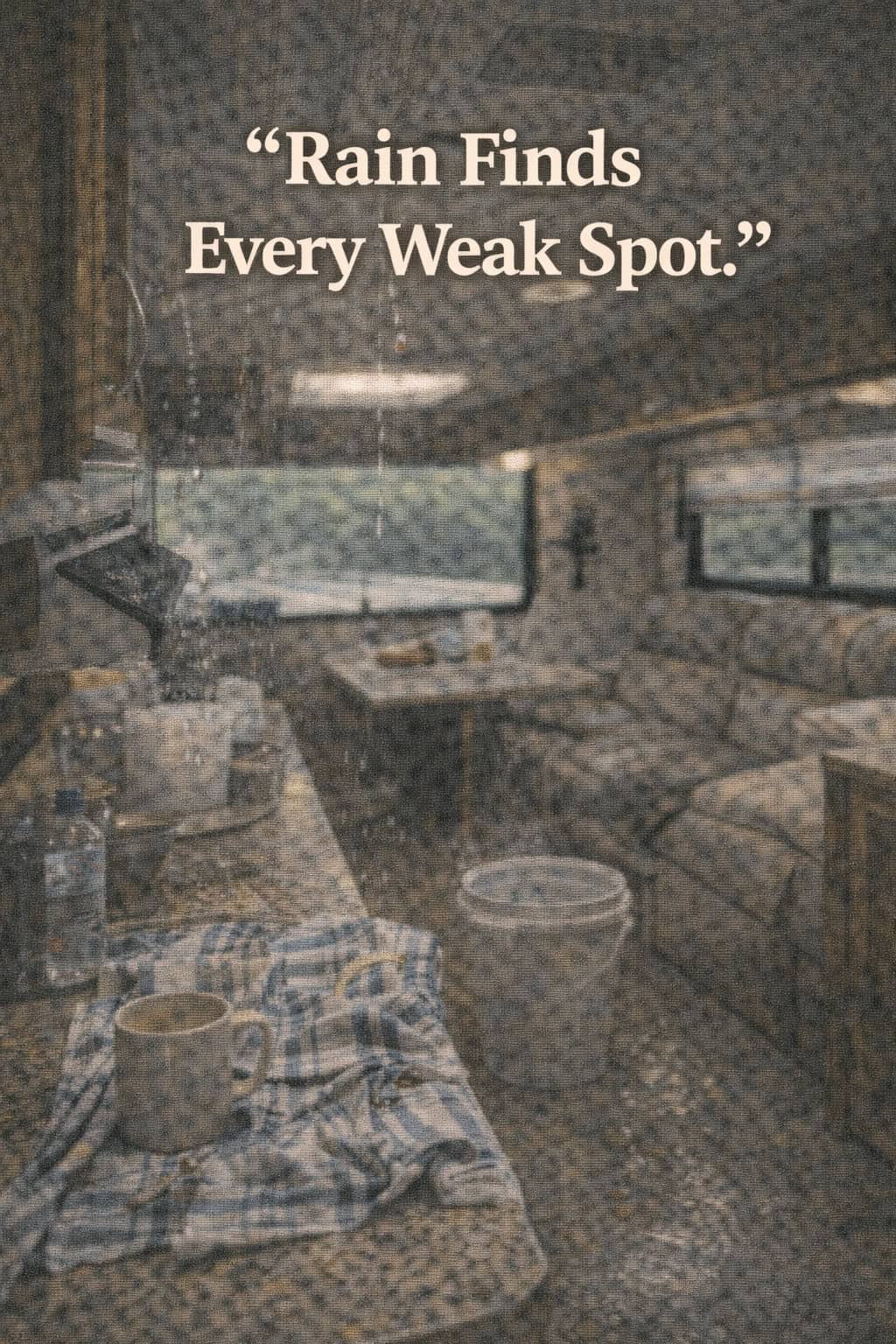
(Because water is patient, persistent, and wildly detail-oriented.)
You can go weeks without thinking about seals, seams, roof edges, or that one window you “meant to check.”
Then it rains.
And suddenly your RV becomes a live demonstration of how many places water is willing to explore if given the slightest opportunity.
Rain doesn’t just fall.
Rain investigates.
And yes—rain finds every weak spot.
☔ 1. Rain Doesn’t Need a Big Gap. It Needs a Chance
The frustrating part is that leaks don’t start with dramatic failures.
They start with:
-
a hairline crack in sealant
-
a loose corner trim
-
a seal that’s “mostly fine”
-
a tiny gap you’d never notice on a dry day
Rain doesn’t care how small it is.
It will find it, test it, and return with friends.
🧱 2. It Targets Seams Like It’s Being Paid
Rain goes for the classics:
-
roof edges
-
slide seals
-
window frames
-
vents
-
marker lights
-
anywhere two materials meet
Those areas flex on the road, heat up in the sun, and age over time.
Rain simply turns that normal wear into a very immediate problem.
🪟 3. Windows Are Innocent Until They Aren’t
A window can look perfect and still let water in because:
-
seals compress and loosen
-
frames shift slightly over time
-
water runs down and pools in odd places
It’s rarely a waterfall leak.
It’s usually a subtle “Why is this damp?” situation—aka the start of a bigger story.
🌬 4. Wind-Driven Rain Is the Real Villain
Normal rain is manageable.
Wind-driven rain is the one that:
-
pushes sideways
-
gets under seals
-
hits the areas that “never get wet”
-
turns your awning into a questionable asset
That’s when you realize you weren’t prepared for weather with ambition.
💧 5. Condensation Pretends to Be a Leak
Sometimes it’s not a leak—it’s condensation.
Rainy-day RV life often creates:
-
humid air
-
cold windows
-
damp surfaces
-
fogging and dripping that looks suspicious
If your windows are sweating and your vents are closed, you can get moisture inside that feels like a leak even when the seals are fine.
Either way: it’s still annoying and still needs managing.
🧼 6. Rain Turns “Minor Maintenance” Into “Immediate Priority”
Rain has a way of making you notice everything:
-
a soft spot you hadn’t felt before
-
a seam that looks “tired”
-
a drip that shows up only under certain conditions
It’s not that the RV suddenly broke.
It’s that water makes hidden issues visible.
And water is excellent at its job.
🧠 7. The Emotional Part: Leaks Feel Like Betrayal
A leak isn’t just inconvenient—it’s stressful because it triggers:
-
worry about hidden damage
-
fear of mold
-
uncertainty about how long it’s been happening
Even a tiny drip can feel huge because you know what water can do over time.
You’re not overreacting.
You’re being appropriately respectful of the enemy.
🛠 8. What Campers Do in the Moment
When rain exposes a weak spot, most of us go into practical mode:
-
towels down immediately
-
move anything valuable away from the area
-
identify the source as best as possible
-
manage airflow to reduce humidity
-
make a plan for a proper fix when conditions improve
It’s not glamorous.
It’s effective.
And it buys time.
💬 Final Thoughts
Rain doesn’t ruin camping.
But it does reveal the truth.
It highlights every seam you ignored, every seal you assumed was fine, and every “we’ll check it later” decision.
The good news? Most issues start small—and catching them early is a win.
So if rain finds a weak spot, don’t take it personally.
Take it as a reminder: your RV is a moving home, and homes need upkeep—especially when water is involved.
🐟 Want to reduce rain regret before you arrive? Use Campground Views to preview site drainage, pad type, tree cover, and exposure—so you can choose spots that handle wet weather better and keep water drama to a minimum.
🔗 Follow us for more RV life truths, weather survival humor, and content for people who’ve absolutely said, “Why is that damp?” and felt their soul leave their body.