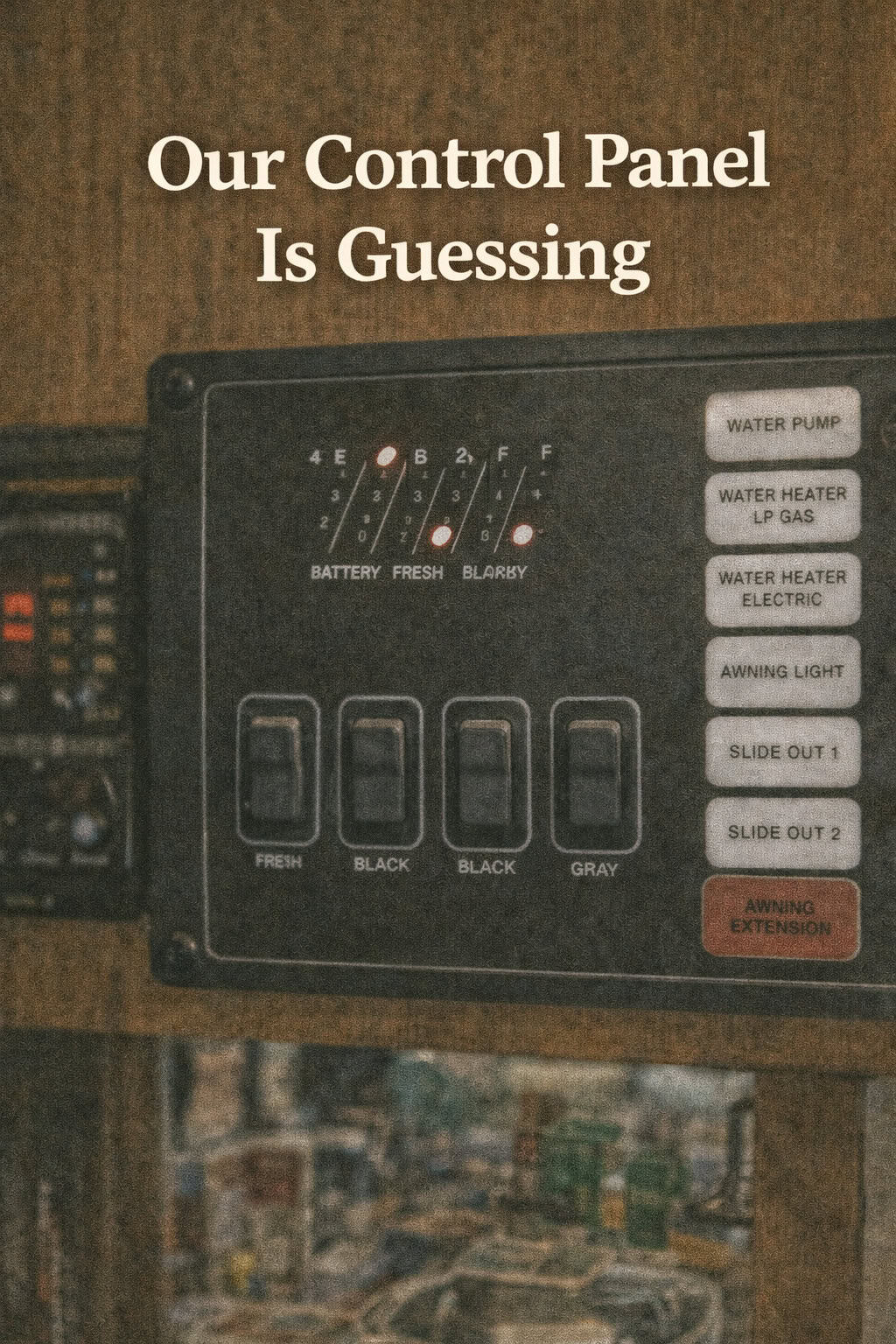
(And doing it with alarming confidence.)
You glance at the control panel expecting clarity.
Numbers. Facts. Reassurance.
Instead, you get vibes.
Fresh water: somewhere between fine and not fine.
Grey tank: empty (while water backs up).
Black tank: two-thirds (it was dumped yesterday).
Battery: blinking (emotionally).
Our control panel isn’t reporting data.
It’s speculating.
📟 1. The Numbers Are Aspirational
Control panels love round numbers:
-
Empty
-
⅓
-
⅔
-
Full
They do not believe in nuance.
Your tank is never actually two-thirds full.
It’s either almost empty, almost full, or actively plotting against you.
The panel just picked a number it felt good about.
🚰 2. Fresh Water Is “Fine” Until It Isn’t
The panel says you’ve got plenty of fresh water.
Your sink says otherwise.
Fresh water readings operate on a delay that feels personal.
They stay optimistic right up until:
-
the pump sputters
-
the flow weakens
-
and someone says, “Uh… guys?”
At that point, the panel will still insist everything is fine.
🧻 3. Black Tank Readings Are Pure Fiction
Let’s be honest.
Black tank sensors are:
-
brave
-
optimistic
-
deeply unreliable
They get confused by:
-
toilet paper
-
residue
-
their own existence
You could dump, rinse, dump again—and the panel will still say: “⅔ full.”
At this point, you don’t read it.
You feel it.
🚿 4. Grey Tank Lies in the Opposite Direction
Grey tank sensors prefer drama.
They’ll show:
-
empty
-
empty
-
empty
And then—surprise—you’re ankle-deep in shower regret.
The panel didn’t warn you.
It observed and chose silence.
🔋 5. Battery Status Is a Mood Ring
Battery indicators are less about voltage and more about vibes.
You’ll see:
-
full bars while everything is plugged in
-
sudden drops when you unplug
-
flashing lights that mean “something”
Is it low?
Is it charging?
Is it judging you for running the microwave?
No one knows.
🧠 6. The Panel Is Never Wrong—Just Inconsistent
The worst part isn’t that it’s inaccurate.
It’s that it’s confident.
It reports its guesses like facts.
No hesitation. No disclaimer.
You want it to say: “I’m not sure, but good luck.”
Instead, it stares back at you like: “Trust me.”
You shouldn’t.
🧰 7. Experienced RVers Don’t Check the Panel First
Veterans use:
-
time since last dump
-
number of showers
-
water pressure feel
-
pump behavior
-
lived experience
The control panel becomes a secondary source.
Like weather apps. Or campground maps.
Helpful context.
Not gospel.
🔄 8. Resetting It Feels Productive (Even If It Isn’t)
You’ll press the reset button anyway.
Why?
-
it feels proactive
-
it suggests control
-
it gives you hope
Sometimes it helps.
Sometimes it changes nothing.
Either way, you tried. And that counts.
😅 9. You Eventually Learn Its Language
Over time, you decode it.
You realize:
-
“⅔” really means “check soon”
-
blinking means “pay attention”
-
silence means “probably fine”
It’s not lying.
It’s speaking RV.
💬 Final Thoughts
Your control panel isn’t broken.
It’s just… optimistic.
It offers suggestions, not guarantees.
Hints, not truths.
Confidence without verification.
Once you stop expecting precision and start pairing it with real-world checks, it becomes less frustrating—and almost charming.
Almost.
🐟 Want to reduce surprise system moments on arrival? Use Campground Views to preview hookups, site layout, and utilities before you book—so you rely less on guessing panels and more on good planning.
🔗 Follow us for more RV life truths, system-with-attitude humor, and content for people who’ve absolutely said, “That can’t be right,” while staring at a blinking light.