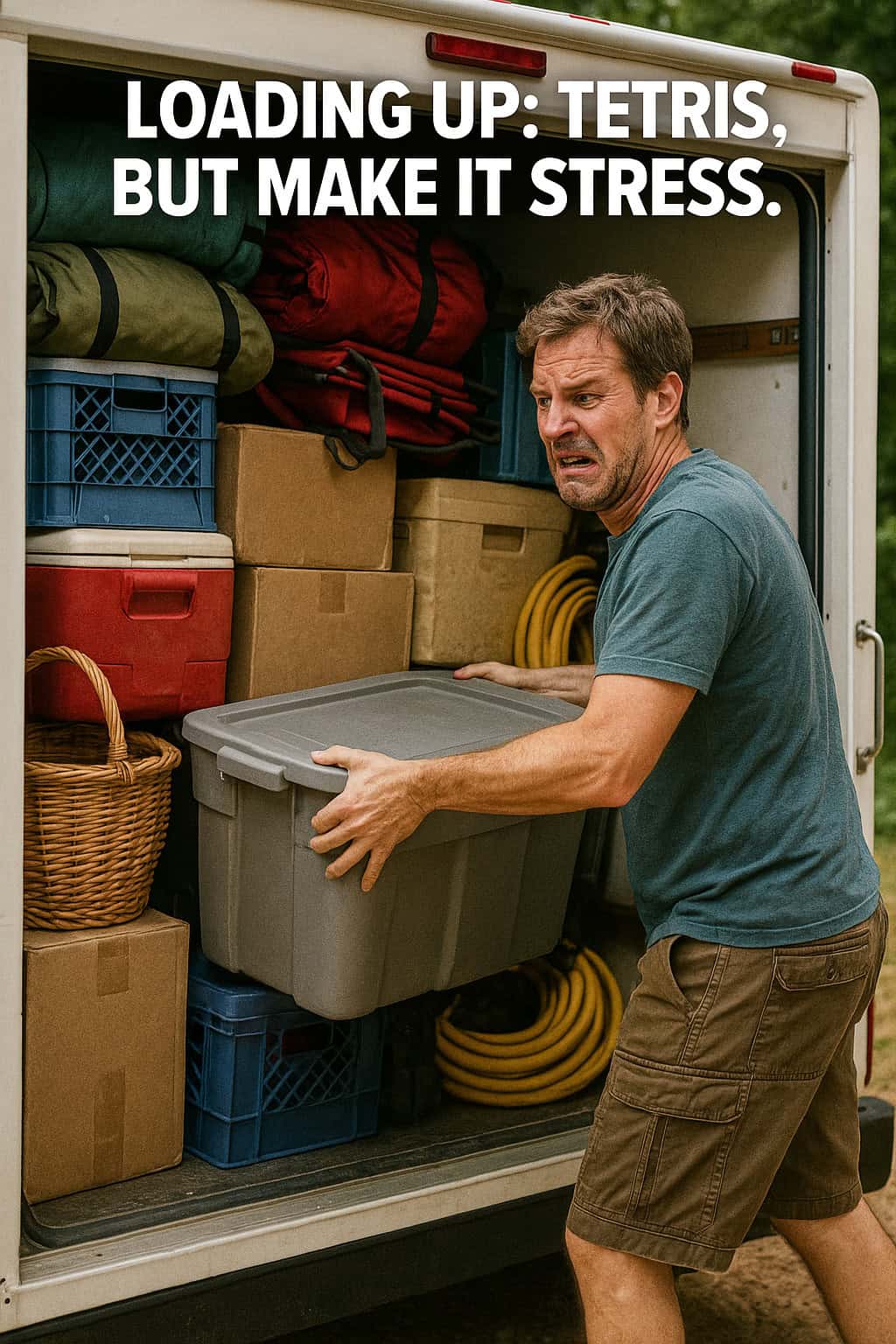
(Because somehow the same stuff takes up 40% more space on departure day.)
Packing for an RV trip feels optimistic.
Loading up for an RV trip feels like a competitive sport you didn’t train for.
Everything is too big.
Nothing fits the way it did last time.
And someone is holding a folding chair asking, “Where does this go?” like you’re the warehouse manager.
It’s Tetris… except the blocks are irregular, the timer is emotional, and the penalty for failure is a cabinet exploding on the first roundabout.
Here’s how real RVers survive “load up” day without turning it into a full-scale operations incident.
📦 1. The Stuff Expands When You’re Not Looking
On the way out, your gear behaves normally.
On the way back in, it’s suddenly:
-
wider
-
stiffer
-
somehow more awkward
That outdoor rug has clearly joined a union and is refusing to fold like it did before. Your chairs now identify as “extra long.” And the hose? It’s developed opinions.
This isn’t you. This is camping physics.
🧠 2. Your Brain Becomes a Storage Algorithm
Loading up requires you to calculate:
-
weight distribution
-
access priorities
-
what can crush what
-
what will fly forward when you brake
You’re not packing. You’re doing logistics.
And the moment you solve one bay, someone brings you one more item and the whole plan collapses.
🔁 3. The “We’ll Just Shove It In For Now” Trap
“For now” becomes:
-
“until we unpack at home”
-
“until it breaks”
-
“until it becomes a rolling hazard”
If you shove it in without securing it, it will:
-
shift
-
rattle
-
damage something
-
or escape entirely like it’s in witness protection
Temporary storage is not real storage. It’s denial with a latch.
🧱 4. Heavy Stuff Low. Always.
This is the boring rule that prevents stress later:
-
heavy gear goes low and secure
-
lighter gear goes up top
-
nothing heavy should be able to roll or slide
If you stack weight wrong, you’ll feel it while driving—and you’ll arrive exhausted from white-knuckle steering and suspicious noises.
🧺 5. Pack by Modules, Not By Panic
The calmest RVers aren’t stronger. They’re more systemized.
Try loading in “modules”:
-
Hookups module: power, water, sewer, adapters, spares
-
Outdoor module: chairs, mat, table bits
-
Tools module: basic tools + quick fixes
-
Kitchen module: essentials only
If your gear is modular, you stop doing the “where’s the thing?” scavenger hunt every trip.
🚪 6. Anything You’ll Need First Goes Last
If your first hour at the next stop requires:
-
chocks
-
leveling blocks
-
power cord
-
water hose
-
gloves
then those items need to be: -
easiest to reach
-
not buried under seven chairs and a folded gazebo you didn’t even use
Departure day loading should still support arrival day setup. Otherwise you’re just moving stress forward.
🪢 7. The True MVPs: Straps, Bungees, and Simple Containment
Loose items are future problems.
Containment is adulting.
Use:
-
bins for small items
-
straps for bulky gear
-
bungees to stop shifting
-
bagged storage for anything that should never touch anything else (looking at you, sewer gear)
A secured load is a quiet drive—and quiet drives are peak luxury.
👀 8. The Final Step Everyone Skips: The “Open It Again” Check
Before you drive off, open the compartments once more and ask:
-
will anything fall out?
-
will anything shift?
-
did we trap a hose in a door?
-
did we just create a rattle symphony?
This 30-second check saves you from a roadside repack that feels like humiliation with a high-vis vest.
💬 Final Thoughts
Loading up isn’t hard because you’re disorganized. It’s hard because RV storage is limited, gear is awkward, and your brain is already halfway to the next destination.
But with modules, priorities, and basic containment, you can turn “Tetris stress” into “close the door and move on” energy.
You’ll still have one item that doesn’t fit. That’s tradition.
Just don’t let it become a projectile.
🐟 Want to know what kind of setup you’ll need at the next stop—tight site, angled pad, slope, short hookups? Use Campground Views to preview site layout and conditions before you arrive, so you can load based on reality, not optimism.
🔗 Follow us for more RV life truths, setup sanity tips, and practical systems that make travel days less stressful and a lot more smooth.