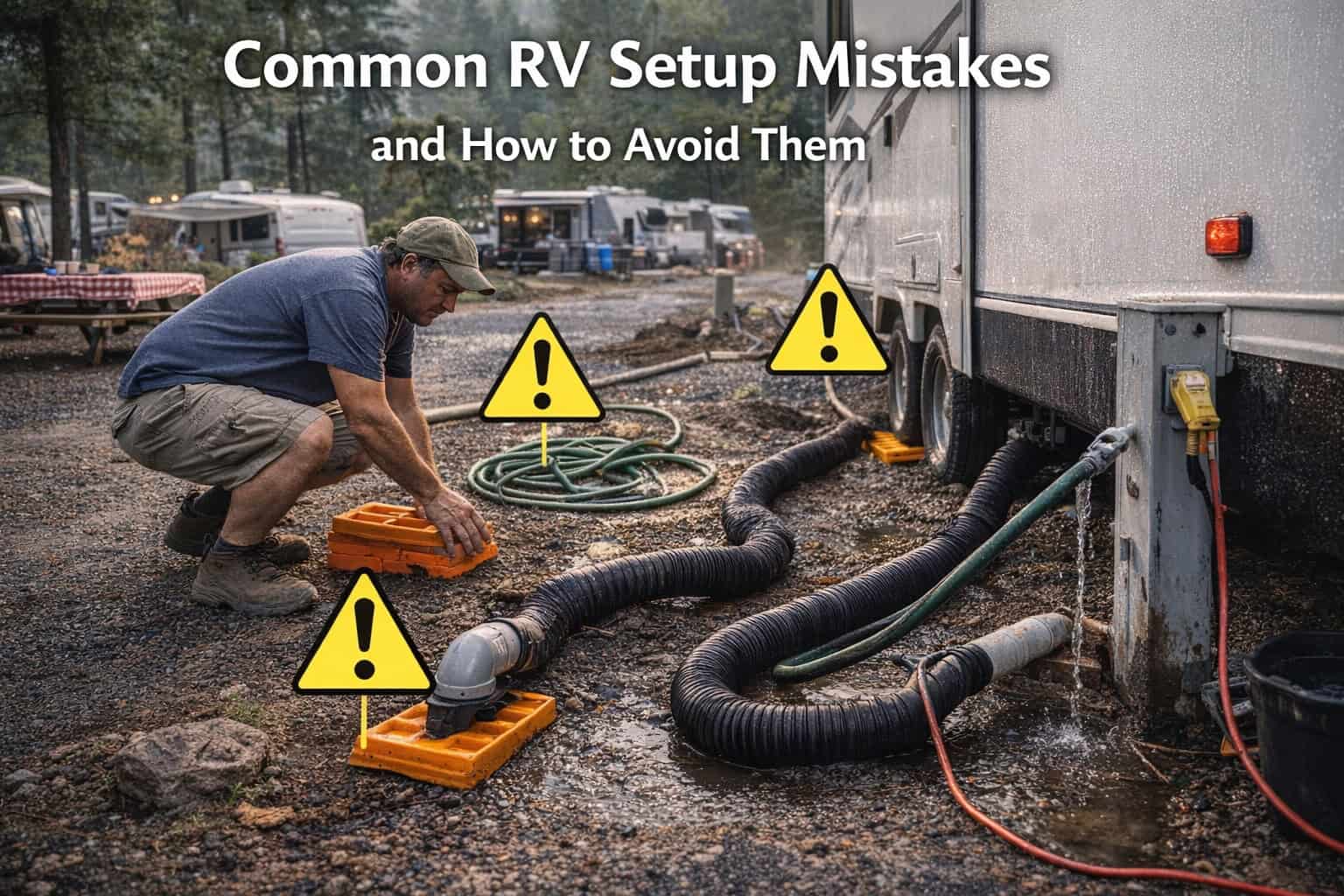
The moment you pull into a site, the clock starts ticking on your "Emotional Time." If the setup goes smoothly, you’re in your camp chair with a cold drink in ten minutes. If it goes poorly, you’re three hours into a domestic dispute with a kinked sewer hose and a rig that’s tilting like the Leaning Tower of Pisa.
Setting up an RV is a Mechanism with many Moving Parts. To reach that "Best-Case Scenario" arrival, you have to avoid the common friction points that trip up even seasoned travelers.
1. The "Eyeball" Leveling Error
The Mistake: Trusting your inner ear or the "look" of the horizon to determine if the rig is level.
-
The Reality: Modern RVs are sensitive. If you are off-level, your absorption refrigerator can fail, your slide-outs can bind or leak, and your shower won't drain.
-
How to Avoid It: Use a graduated level or a digital leveling system. Always level side-to-side before unhooking from the tow vehicle using blocks or ramps. Only after you are side-to-side level should you unhook and manage the front-to-back leveling.
2. The "Slide-Out" Surprise
The Mistake: Deploying your slides before checking the exterior clearance.
-
The Reality: It’s easy to forget that your rig grows by three feet on each side. If there’s a utility pedestal, a tree, or a low-hanging branch in the way, you’re looking at a multi-thousand-dollar body shop bill.
-
How to Avoid It: Before you even unhook, do a "Visual Sweep." Better yet, use a "slide-out stick" (a PVC pipe cut to the length of your slide) to physically verify there is enough room for the Mechanism to participate without hitting an obstacle.
3. The Utility "Reverse Order"
The Mistake: Hooking up the sewer first, or failing to use a surge protector/water pressure regulator.
-
The Reality: Campground "Conditions Are Not Neutral." Power surges can fry your electronics, and high water pressure can burst the PEX lines behind your shower.
-
How to Avoid It: 1. Power First: Plug in your surge protector before the RV to ensure the "Readout is Confident." 2. Water Second: Always use a pressure regulator at the spigot. 3. Sewer Last: Ensure your hose has a steady "slope" toward the drain—no "camel humps" that trap waste.
4. Forgetting the "Lock-Down"
The Mistake: Leaving your stabilizers up or forgetting to chock the wheels.
-
The Reality: A "Livable" RV shouldn't feel like a boat. If you don't chock your wheels before unhooking, the rig can roll. If you don't deploy stabilizers, every time someone walks to the bathroom, the whole unit will rock.
-
How to Avoid It: Make "Chocks First" your golden rule. Once leveled and unhooked, deploy your stabilizers until they are snug—but remember, stabilizers are not jacks. Do not try to lift the rig with them.
Key Tip: The "Final Walk-Around." Once you think you’re done, walk 360 degrees around the rig. Look for loose caps, dangling wires, or basement doors that didn't quite latch. This two-minute "Attention" check saves an hour of "Firefighting" later.
Final Thoughts
Setting up isn't just a chore; it’s the foundation of your "Vibe." When you avoid these common pitfalls, you move from the "Chaos of Arrival" to the "Stability of Camping" in record time. Treat your setup like a professional "SOP" (Standard Operating Procedure), and you'll find that the "Reality Phase" of your vacation is much more enjoyable.
🐟 Want to avoid the biggest setup mistake of all—booking a site that doesn't fit your rig? Eliminate the guesswork. CampgroundViews.com provides 360-degree virtual tours that allow you to see the utility placement, the slide-out clearance, and the level of the pad before you ever leave your driveway.
Plan your perfect arrival at CampgroundViews.com!