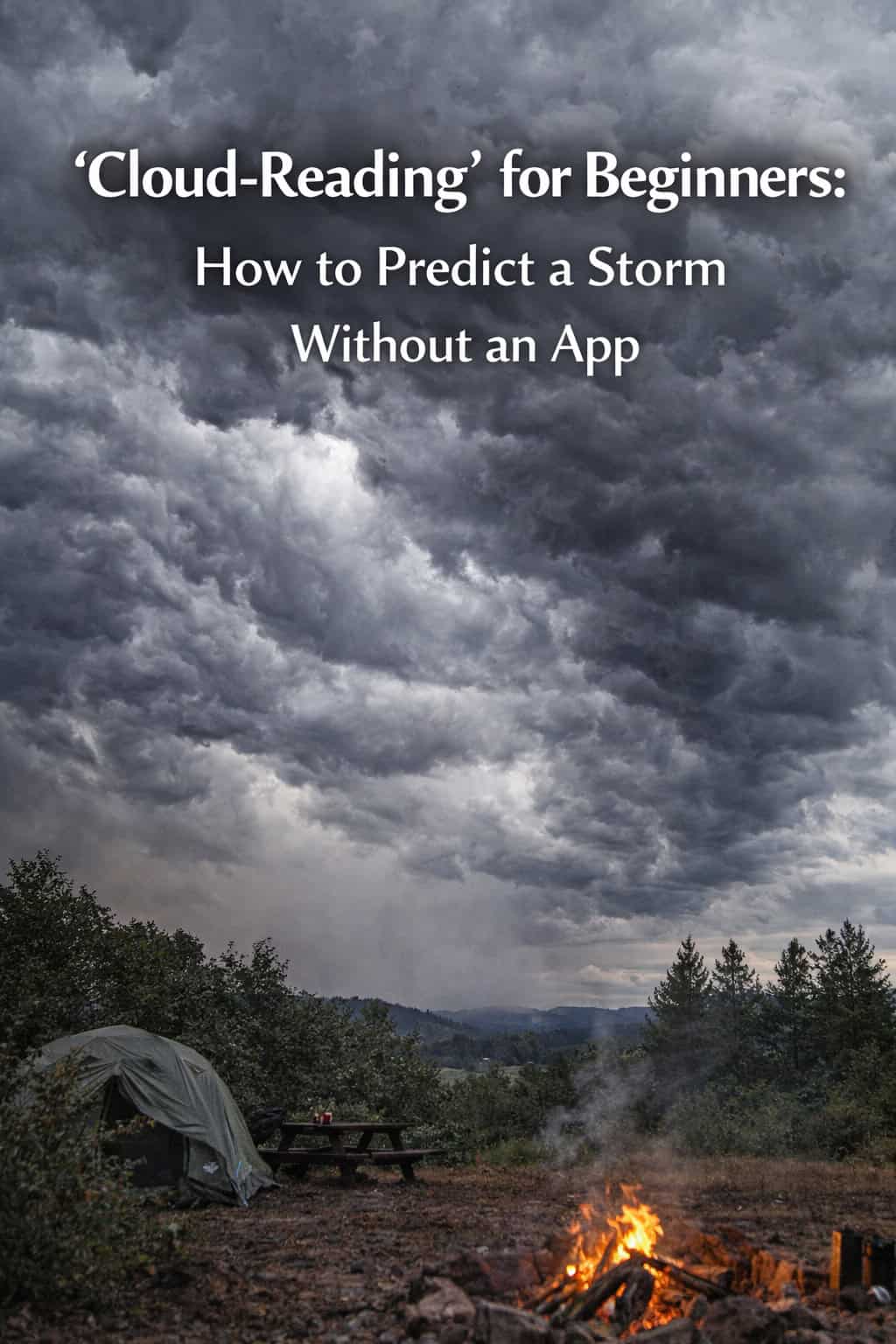
How to Use the Sky as Your Early-Warning System
You’re out on a hike, miles from the RV, and your phone says "No Service." You want to know if you have time to reach the summit or if you should turn back and save the marshmallows from the coming rain.
The sky is constantly "writing" a weather report; you just need to know how to read the font. By understanding the Physics of Cloud Formation, you can predict a storm hours before the first drop falls. Here is your guide to being a Campsite Meteorologist.
1. The "Fair-Weather" Cotton Balls (Cumulus)
The Look: These are the classic, puffy white clouds that look like giant cotton balls or popcorn. They have flat bottoms and rounded tops.
-
The Science: These clouds form when warm air rises, cools, and the water vapor "clumps" together (condenses).
-
The Forecast: As long as they stay small and white, you’re in the clear! They are "Happy Clouds" that mean the air is stable.
-
The Warning: If they start growing taller than they are wide, they are turning into "Towering Cumulus." That means the atmosphere is getting "angry."
2. The "Anvil" of Doom (Cumulonimbus)
The Look: These are giant, dark mountain-clouds. The most dangerous sign is when the top of the cloud flattens out, looking like a blacksmith’s Anvil.
-
The Physics: The cloud is growing so fast and so high that it hits the top of the "Troposphere" (the bottom layer of our atmosphere). It can't go up anymore, so it spreads out sideways.
-
The Forecast: Take Cover. An anvil cloud means high winds, heavy rain, and likely lightning. If the bottom of the cloud looks dark blue or gray-green, the "Rainforest" is about to open up.
3. The "High-Altitude" Warning (Cirrus)
The Look: Thin, wispy white lines that look like "Mare’s Tails" (horse tails) way up in the sky.
-
The Science: These clouds are so high (over 20,000 feet) that they are made entirely of Ice Crystals, not water drops.
-
The Forecast: Cirrus clouds are the "Scouts" for a coming storm. They often arrive 24 hours before a "Warm Front."
-
The Pro Tip: If the sky looks like it’s covered in "Fish Scales" (small, rippled clouds called Cirrocumulus), a change in weather is definitely coming by tomorrow.
4. The "Halos" and "Sun Dogs"
The Science: Sometimes, the sun or moon has a giant glowing ring around it.
-
The Physics: This is caused by light Refracting (bending) through the ice crystals in high clouds.
-
The Old Sailor’s Saying: "Ring around the moon, rain is coming soon." * The Accuracy: This is actually true! The high-altitude moisture that creates the halo is often the leading edge of a large rain system.
5. The "Smell" of a Storm
The Science: Your nose can "read" the clouds, too!
-
The Physics: Right before a storm, the falling air pressure releases scents trapped in the soil and plants. This creates a sweet, earthy smell called Petrichor.
-
The "Ozone" Clue: If the air smells sharp and "metallic" (like a copy machine), that’s Ozone. It’s created when lightning strikes high up in the clouds and the wind pushes that air down to the ground.
-
The Warning: If you smell ozone, the storm is very, very close!
Pro Tip: The "Rule of Five." If you see lightning, count the seconds until you hear thunder. For every 5 seconds you count, the storm is 1 mile away. If you count to 15, it's 3 miles away. If the number is getting smaller each time, the "Anvil" is headed straight for your campsite!
Final Thoughts
Being a cloud-reader makes you feel connected to the rhythm of the Earth. You’ll find that you stop looking at your phone and start looking at the horizon. By spotting the "Mare's Tails" or the "Anvils" early, you can be the hero who gets the laundry off the line and the campfire covered before the first splash.
Keep your head in the clouds, Scientist!
🐟 Want to find a site with a "Big Sky" view for cloud-watching? You don't want to be tucked under a thick canopy if you're trying to spot a coming front! CampgroundViews.com lets you take a 360-degree tour of the park. You can look at the "Openness" of each site to make sure you have a clear view of the horizon for your meteorological mission.
Scout your "Weather Station" at CampgroundViews.com!