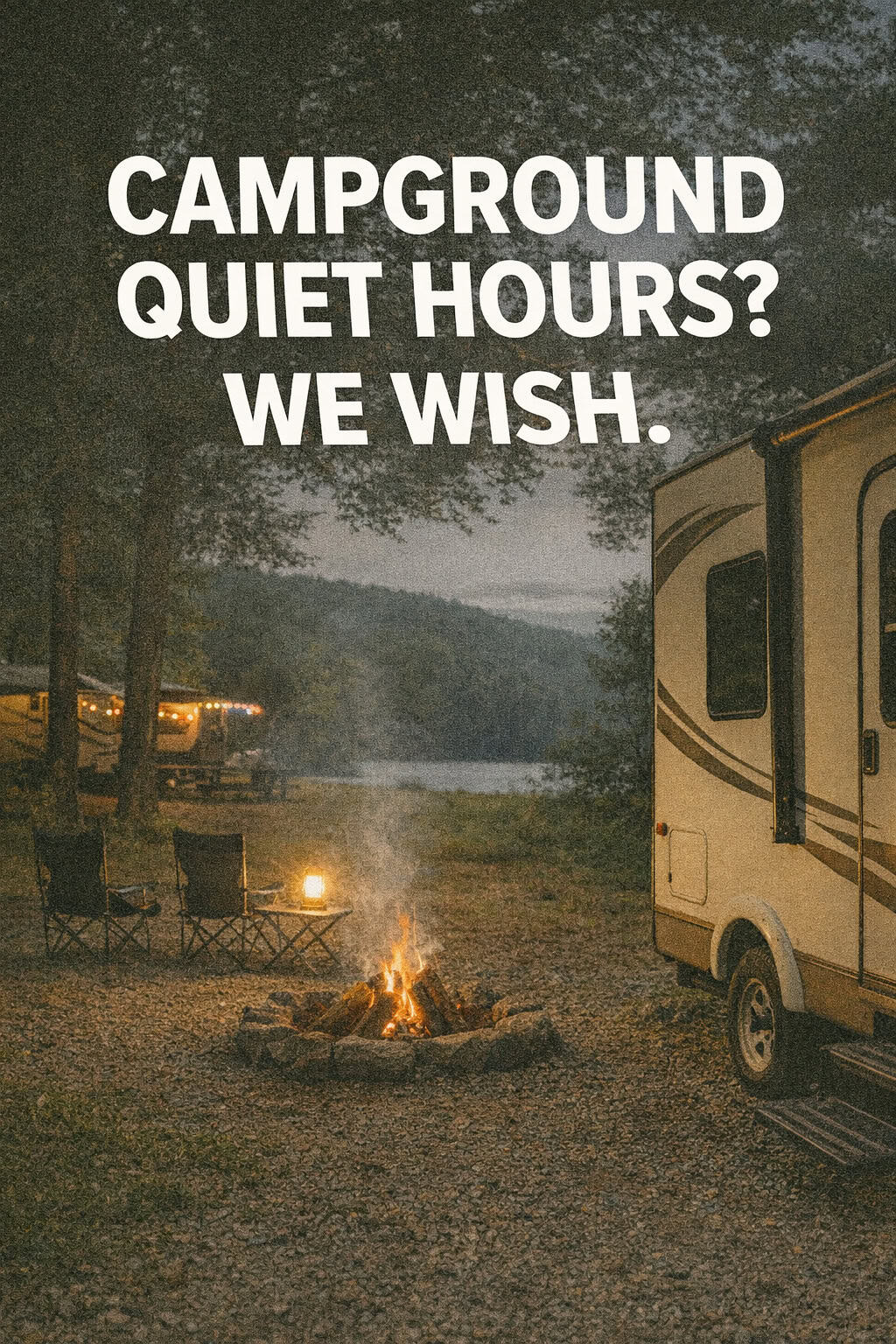
(Because silence is apparently a flexible concept.)
Every campground has quiet hours.
They’re written on signs.
Printed on maps.
Mentioned at check-in with confidence.
And yet—somehow—once the sun goes down, those hours become more of a theoretical framework than an actual rule.
You didn’t expect monastery-level silence.
You just didn’t expect this.
Here’s the honest reality of campground quiet hours—and why they so often feel aspirational.
🔇 1. Quiet Hours Mean “Quiet for Some People”
For you, quiet hours mean:
-
lower voices
-
no music
-
gentle door closing
-
whisper-level chaos
For others, quiet hours mean:
-
“inside voices, but outside”
-
one last song (every song)
-
shouting conversations across sites
-
laughing louder because it’s dark
Same sign. Very different interpretations.
🔊 2. Sound Travels Like It’s Got a Mission
Campgrounds have terrible acoustics and excellent echo potential.
Which means:
-
a conversation three sites over feels like it’s in your rig
-
one generator sounds like five
-
a single laugh carries like a foghorn
Nobody is necessarily that loud.
The environment is just aggressively unhelpful.
🎶 3. Music Volume Is Always One Notch Too High
No one thinks their music is loud.
It’s:
-
“just background”
-
“barely on”
-
“we turned it down already”
Meanwhile, you can identify the playlist genre, the artist, and the emotional phase of the evening.
Bonus frustration: it’s never music you’d choose voluntarily.
🐕 4. Dogs Did Not Agree to Quiet Hours
Some dogs understand night-time calm.
Others see darkness as a call to duty.
You hear:
-
alert barking
-
reactive barking
-
“I heard something” barking
-
“I’m bored” barking
You feel bad for the owners.
You still want sleep.
Two things can be true.
🚪 5. Door Slams Multiply After 10 p.m.
All day? Soft closes.
After quiet hours? Absolute violence.
You hear:
-
entry doors
-
storage bays
-
screen doors
-
mysterious clanging that no one admits to
It’s not intentional.
It’s just the universe testing your patience.
🌙 6. Late-Night Pack-Ups Are a Special Kind of Rude
Sometimes people have reasons to leave early. That’s fair.
But there’s always one pack-up that includes:
-
full lighting
-
loud conversations
-
repetitive slamming
-
engine revving like a send-off parade
You lie there thinking,
“Just… quietly… go.”
They do not.
🤝 7. Most People Aren’t Being Rude on Purpose
This part matters.
Most campers:
-
lose track of time
-
don’t realize how far sound carries
-
assume “it’s fine” because no one’s said anything
Annoying? Yes.
Malicious? Usually no.
Which is why calm, polite approaches often work—when they’re needed.
🧠 8. The Veteran Camper Survival Kit
Experienced RVers don’t rely on quiet hours alone.
They bring:
-
earplugs (elite-tier camping gear)
-
white noise or fans
-
realistic expectations
-
the ability to let small stuff go
Because waiting for perfect silence in a campground is like waiting for the wind to behave.
😅 9. You’ll Still Complain About It Tomorrow
You’ll wake up and say:
-
“People were loud last night.”
-
“Quiet hours don’t mean anything.”
-
“I barely slept.”
And then:
-
you’ll make coffee
-
enjoy the morning calm
-
and forget about it just enough to book another trip
Because despite the noise, you still love this life.
💬 Final Thoughts
Campground quiet hours aren’t a guarantee.
They’re a guideline filtered through humans, dogs, acoustics, and poor timing.
If you want absolute silence, camping probably isn’t it.
But if you want shared space, fresh air, and the occasional night of muttered complaints followed by a great morning? You’re in the right place.
🐟 Want to reduce noise roulette before you arrive? Use Campground Views to preview site spacing, loop layout, and proximity to high-traffic areas like bathrooms, playgrounds, and entrances—so you can choose quieter zones when they exist.
🔗 Follow us for more RV life truths, campground reality checks, and humor for people who’ve absolutely whispered, “Is it still quiet hours?” into the dark.