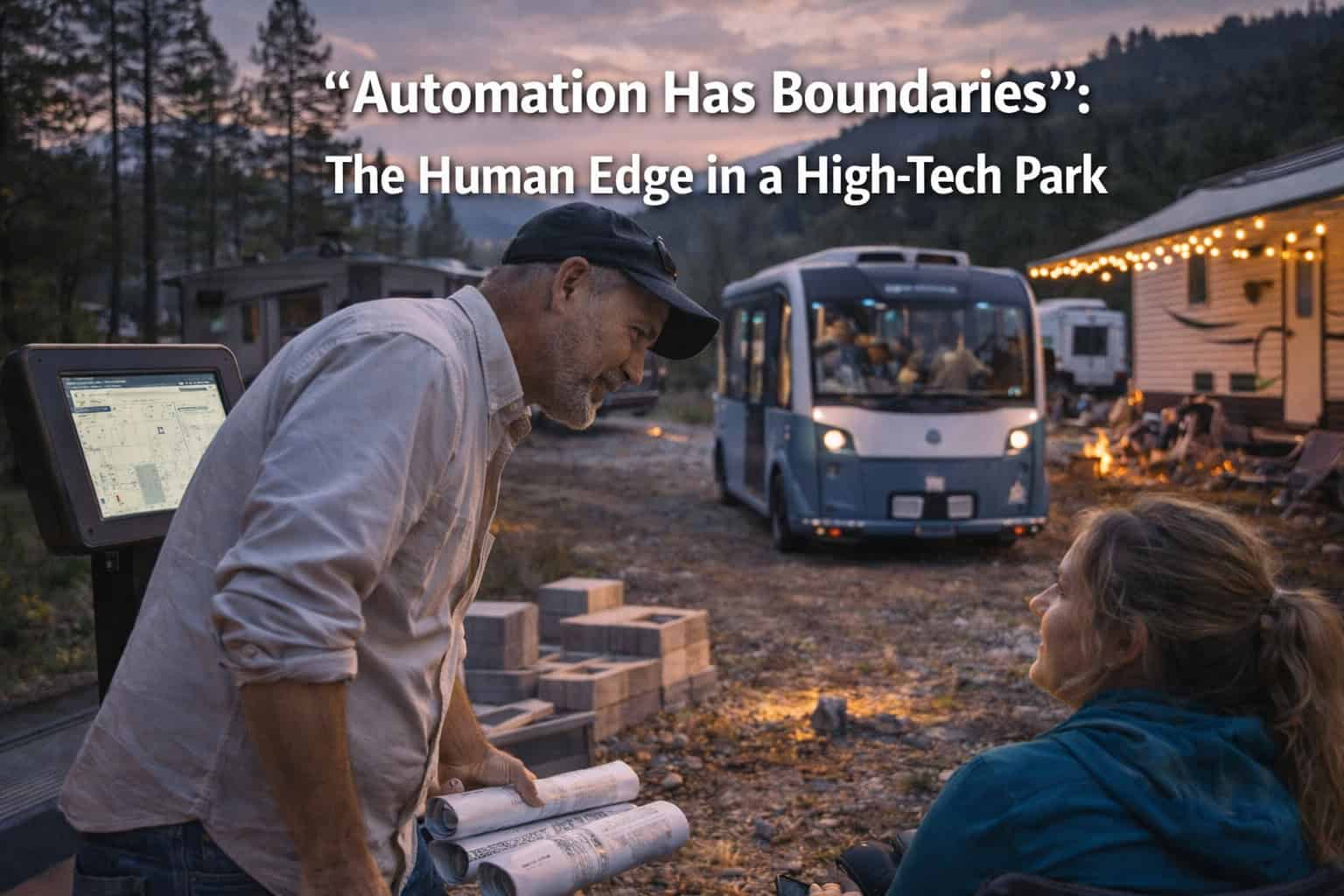
We’ve all been there: a guest is stuck at a digital kiosk that won’t read their reservation, or an automated gate arm refuses to budge because a trailer is triggering a safety sensor. In our quest for efficiency, it’s easy to buy into the dream of the "autonomous campground." But as every seasoned operator eventually learns, automation has boundaries.
Technology can handle the data, but it can’t handle the nuance. In the RV industry, the "human edge" isn't just a nice-to-have; it is the final, essential layer that keeps the park from feeling like a vending machine.
1. The "Case-by-Case" Reality
Automation thrives on "either/or" logic. If the guest has a code, the gate opens. If they paid, the reservation is confirmed. But camping is a "both/and" world.
-
The Rig That Doesn't Fit: A computer doesn't know that a guest's brand-new 45-foot Class A has a low-hanging exhaust that will bottom out on a specific bump in Site 7. Automation would book that site; a human manager knows to "Interpret" the situation and move them to Site 10.
-
The Weather Pivot: When a "Conditions Are Not Neutral" event occurs—like a sudden freeze—automation might keep your irrigation system on a timer. It takes a human to step in, override the system, and prevent a catastrophic pipe burst.
2. The Emotional Limitation of Algorithms
You cannot automate empathy. When a traveler arrives after a grueling day of engine trouble and rain, they aren't looking for a QR code to scan.
-
De-escalation: An automated email can’t sense frustration. A human staff member can see the tension in a guest's shoulders and offer a cold bottle of water or a simple, "We’ve got you, let’s get you parked." That interaction turns a potential bad review into a "Familiar" loyalist.
-
The "Vibe" Check: Automation can’t tell if a group is getting too rowdy for quiet hours before a complaint is filed. A human "Walk-Around" catches the energy shift early, allowing for a friendly reminder rather than a late-night confrontation.
3. Strategic Automation: Finding the Balance
The goal isn't to reject technology, but to define its borders. Use automation to handle the "boring" so your people can handle the "being."
-
Automate the Transaction, Not the Relationship: Let the software handle the credit card processing, the confirmation emails, and the tax documents. This clears the "Administrative Layers" so your team can spend more time at the sites and less time at the desk.
-
Human Overrides: Every automated system in your park—from the gate to the HVAC in the clubhouse—should have a manual override that is easily accessible. Never let the "Mechanism" be the boss of the "Owner."
Key Tip: The "Two-Minute" Rule. If a guest has to spend more than two minutes fighting with an automated system, the automation has failed. At that point, a human must be present to "Acknowledge" the issue and provide the solution.
Final Thoughts
The most successful campgrounds of 2026 are those that use high-tech tools to provide high-touch service. "Automation Has Boundaries" is a reminder that your park's soul lives in the moments that can't be programmed. When you respect the limits of your tools and lean into the strengths of your people, you create an experience that feels seamless, supported, and—most importantly—human.
🐟 Want to use technology to enhance human connection, not replace it? Give your guests the ultimate self-service tool that feels like a personal tour. CampgroundViews.com provides 360-degree virtual tours that answer the "human" questions—like "How much shade is there?" or "Where is the best view?"—allowing your staff to focus on the welcome.
Find the balance at CampgroundViews.com!